In modern commercial buildings—such as high-end shopping malls, hotels, and residential towers—kitchen exhaust cannot simply be blown out an open louver.
High-heat commercial cooking (charcoal grilling, wok frying, deep frying, and rotisseries) releases a complex cloud of hot grease aerosols, fine carbon soot, and pungent cooking odors. Discharging this raw exhaust through standard ductwork creates three serious hazards:
- Flammable Duct Fire Loads: Microscopic grease vapors condense into a sticky, flammable fuel sludge along duct walls, turning building shafts into severe fire hazards under NFPA 96 fire codes.
- Odor and Smoke Complaints: Cooking odors and visible blue smoke travel into neighboring residential apartments, hotel guest rooms, or into nearby fresh air intakes (FAHUs).
- Municipal Violations and Fines: Environmental health and civil defense authorities enforce strict rules against visible smoke and nuisance odors, shutting down non-compliant restaurant kitchens.
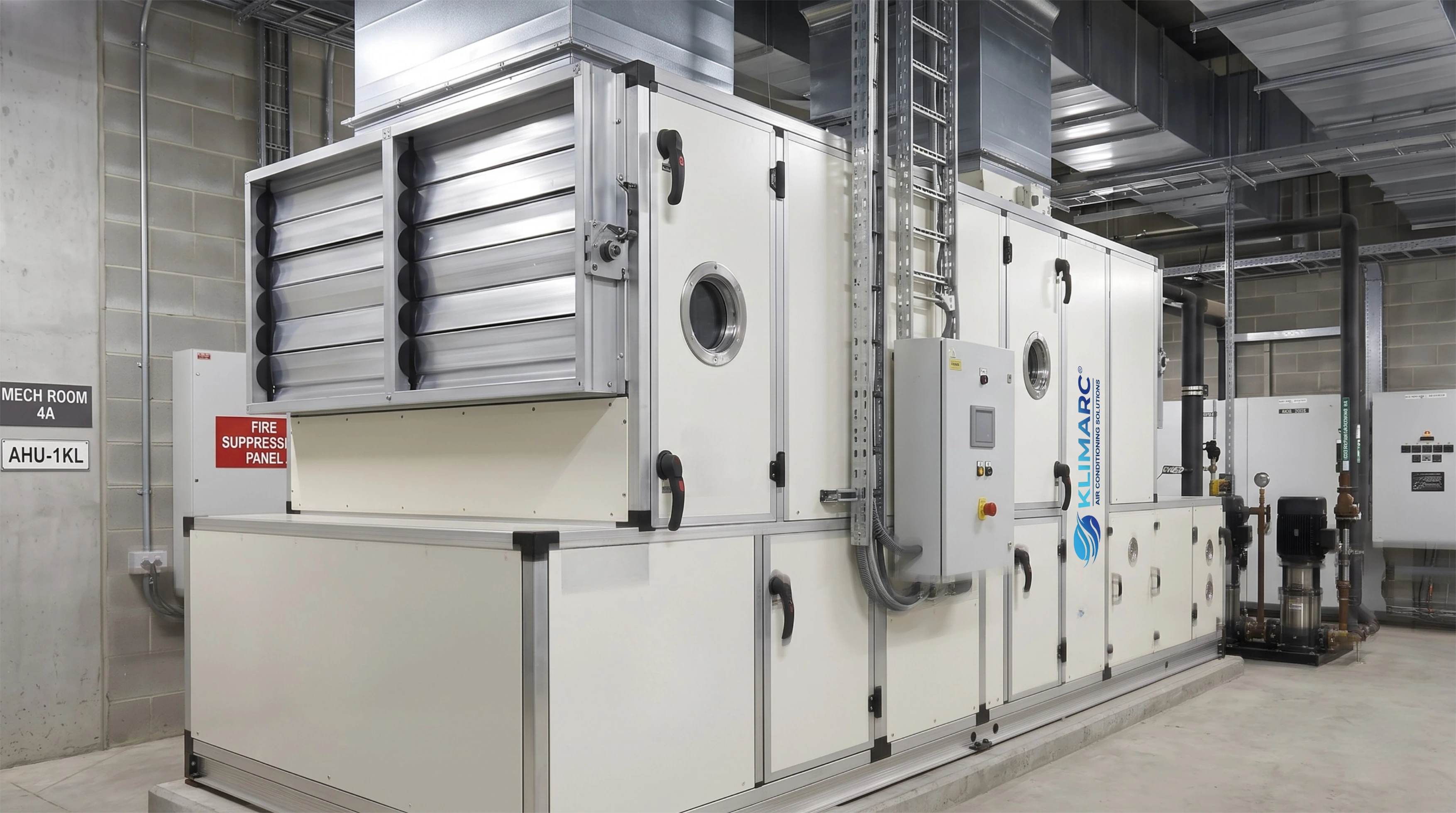
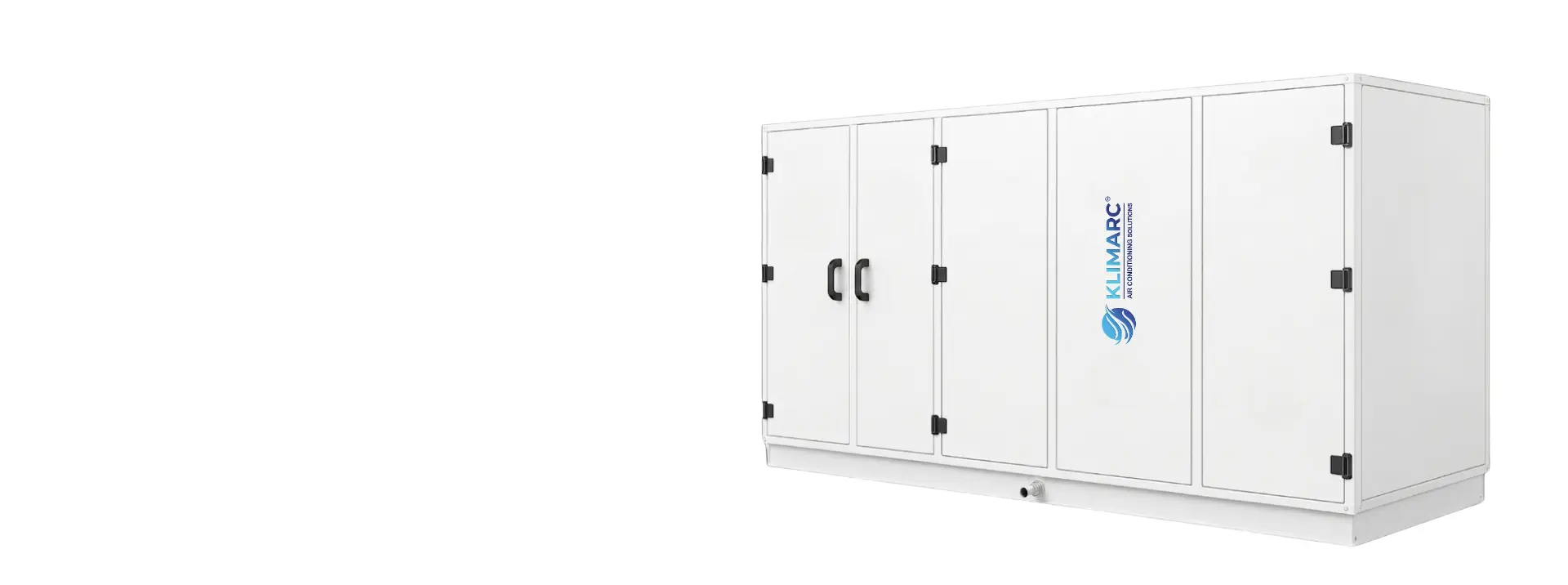
To solve this, building designers specify KLIMARC ARC Kitchen Ecology Units (also called Pollution Control Units), manufactured in Ras Al Khaimah by Klima Air Conditioning Machines Manufacturing LLC.
- High-Efficiency Electrostatic Precipitators (ESP): Captures 95% to 98%+ of sub-micron grease and smoke particles down to 0.01 µm using high-voltage electrical ionization.
- Deep-Bed Activated Carbon Adsorption: Cylindrical virgin activated carbon canisters (> 1,050 m²/g internal surface area) strip gaseous odors and cooking VOCs on a molecular level.
- Heavy-Duty Double-Skin Casing: Built in accordance with Eurovent EN 1886 standards with 50 mm to 75 mm non-combustible rockwool insulation (70 kg/m³) to withstand 50°C+ outdoor temperatures without sweating.
- F400 Certified Fire-Rated Fans: High-temperature backward-curved fans certified to operate continuously for 2 hours at 400°C (752°F) during a kitchen fire emergency.
1. Why Standard Kitchen Exhaust Systems Fail in Modern Buildings
A traditional commercial kitchen exhaust system relies on a kitchen hood fitted with standard stainless steel baffle filters, connected to an exhaust fan via ductwork. While baffle filters stop large oil splatters, their capture mechanism—inertial impaction—relies purely on particle weight.
The Three Physical Phases of Cooking Exhaust
When cooking oils and fats reach high temperatures (185°C to 235°C), they thermally break down into three distinct pollutant phases:
- 1. Large Liquid Droplets (> 10 µm): Heavy cooking spatters. Standard canopy baffle filters catch about 30% to 45% of this weight because these large droplets have enough momentum to collide with the metal baffles and drain away.
- 2. Fine Grease Aerosols and Smoke (0.01 µm to 3.0 µm): Microscopic grease mists and carbonized smoke particles. These particles are so light that they behave like a gas, effortlessly curving around baffle filter blades and traveling straight into the exhaust ductwork.
- 3. Gaseous Odor Molecules (< 0.001 µm): Vaporized volatile organic compounds (VOCs)—such as aldehydes, fatty acids, and sulfur compounds. These are individual gas molecules that pass through all mechanical mesh and fibrous filters unimpeded.
The Dangers of Untreated Exhaust
Without downstream treatment in an Ecology Unit, commercial kitchens encounter three critical problems:
- Fuel Buildup Inside Ducts: As warm grease vapor travels along cooler ducts, it condenses into a thick, flammable layer of oil sludge. A single stovetop flare-up can ignite this sludge, spreading a dangerous fire up through the building.
- Smoke Re-Entrainment: In dense urban centers or shopping malls, cooking exhaust discharged from rooftops or side louvers is frequently sucked straight into nearby Fresh Air Handling Units (FAHUs), pumping barbecue and frying odors directly into hotel lobbies and office desks.
- Facade Staining and Fines: Grease and soot coat the building facade and trigger environmental notices from local municipal inspectors.
2. Anatomy of a Multi-Stage KLIMARC ARC Ecology Unit
To ensure air discharged from a restaurant is crystal clear and odor-free, the KLIMARC ARC Ecology Unit processes exhaust fumes through up to six sequential treatment stages inside an airtight, insulated housing:
| Stage | Filtration Module | Target Pollutants | How It Works | Typical Air Resistance (ΔP) |
|---|---|---|---|---|
| Stage 1 | Washable Metal Pre-Filter | Large grease droplets & lint (> 10 µm) | Equalizes airflow across the casing and catches heavy oil drops before they reach electrical components. | 45 Pa (Clean) / 120 Pa (Dirty) |
| Stage 2 | Electrostatic Precipitator (ESP) | Fine smoke & sub-micron grease (0.01 to 10 µm) | High-voltage ionization charges particles (+12 kV) and pulls them onto grounded collection plates (+6 kV). | 60 Pa / 100 Pa |
| Stage 3 | UV-C Photolytic Ozone Module (Optional) | Remaining grease vapors & heavy VOCs | Ultraviolet light breaks down volatile organic chains through photolytic oxidation. | < 15 Pa |
| Stage 4 | Fine Bag / Pocket Filter | Agglomerated soot & mineral ash (0.3 to 1.0 µm) | Polishing filter (ISO ePM1) that protects the microscopic pores of downstream carbon cylinders. | 90 Pa / 250 Pa |
| Stage 5 | Activated Carbon Bank | Gaseous cooking odors & VOCs (< 0.001 µm) | Deep-bed virgin activated carbon cylinders trap gaseous odor molecules inside microscopic pores. | 110 Pa / 160 Pa |
| Stage 6 | F400 Fire-Rated Exhaust Fan | Overcomes system duct resistance | Backward-curved high-pressure impeller certified to run for 2 hours at 400°C during emergency fires. | Matched to ductwork ESP |
3. The Physics of Two-Stage Electrostatic Precipitators (ESP)
The core workhorse of a Kitchen Ecology Unit is the Two-Stage Electrostatic Precipitator (ESP). Unlike traditional fabric air filters—which quickly clog with sticky cooking grease and choke off airflow—an ESP removes fine smoke with high efficiency while creating almost no resistance to airflow (ΔP < 80 Pa).
Step-by-Step Electrostatic Separation
-
Step 1: Corona Ionization (12,000 to 14,000 Volts DC):
As grease-laden air enters the ESP cell, it passes through an array of fine tungsten ionizing wires charged to +12 kV to +14 kV DC. This intense electric field strips electrons from surrounding air molecules, creating a corona discharge flooded with positive ions. As smoke and grease particles pass through, they collide with these ions and acquire a strong positive electrical charge (+q). -
Step 2: Coulombic Collection (6,000 to 7,000 Volts DC):
Next, the charged particles enter a series of parallel aluminum plates spaced closely together. Alternate plates are charged to +6 kV while the interleaving plates are grounded (0 V). Governed by Coulomb's Law (Force = Charge × Electric Field, or F = q · E), the positively charged grease droplets are repelled by the high-voltage plates and driven forcefully onto the grounded collector plates. -
Step 3: Coalescence and Drainage:
When microscopic grease droplets strike the smooth collector plates, they combine into larger liquid oil drops that slide down by gravity into a stainless steel collection drain pan.
The Deutsch-Anderson Efficiency Equation
The collection efficiency (η) of an Electrostatic Precipitator is calculated using the Deutsch-Anderson formula:
Where η is capture efficiency (0.95 to 0.99), we is particle drift velocity (how quickly particles move toward the plates), A is the total collector plate surface area (m²), and Q is airflow volume (m³/s).
The Key Takeaway: Capture efficiency depends exponentially on plate area (A) and air velocity. If an ecology unit is undersized and air is forced through too fast, smoke particles will rush past before the electric field has time to pull them onto the plates. KLIMARC sizes all ESP cells to maintain internal air velocity between 1.8 m/s and 2.5 m/s (350 to 500 FPM), guaranteeing 95% to 98%+ smoke removal.
4. Gas-Phase Odor Control: Virgin Activated Carbon Adsorption
A common misconception is that an Electrostatic Precipitator alone will remove cooking odors. While an ESP removes 98% of visible smoke and liquid grease droplets, cooking odors are predominantly in the gas phase.
Molecules responsible for pungent aromas (such as grilled meat, fried fish, onions, and spices) have diameters smaller than 0.001 µm (1 nanometer). Because they are gaseous molecules rather than suspended liquid droplets, they carry no particle mass and pass straight through an electric field.
How Activated Carbon Traps Odor Molecules
Stage 5 of the KLIMARC Ecology Unit uses heavy-duty cylindrical canisters packed with Virgin Activated Carbon:
- Vast Internal Surface Area: Activated carbon is treated with steam at high temperatures, creating a maze of microscopic pores. A single gram of high-grade activated carbon has an internal surface area exceeding 1,050 square meters—larger than an entire tennis court!
- Physical Adsorption: As odor-laden air flows through the carbon bed, gaseous odor molecules are drawn into these microscopic pores and trapped permanently by intermolecular attractions (Van der Waals forces).
Calculating Carbon Residence Contact Time (tc)
Adsorption does not happen instantaneously; odor molecules need enough time inside the carbon bed to diffuse into the pores. The Residence Contact Time (tc) is calculated as:
Where Vcarbon is the total volume of activated carbon in the unit (m³) and Q is airflow (m³/s).
| Odor Intensity | Typical Kitchen Type | Minimum Residence Time (tc) | Recommended Configuration |
|---|---|---|---|
| Moderate Odor | Cafes, bakeries, continental kitchens | 0.08 to 0.10 seconds | Virgin Activated Carbon (CTC 60%) |
| Heavy Odor | Burger restaurants, fast food, Asian wok cooking | 0.12 to 0.15 seconds | High-Density Virgin Carbon (CTC 70%) |
| Extreme Odor | Charcoal grills, seafood, street-level discharge | 0.16 to 0.20+ seconds | Dual Carbon Bank + KMnO4 Chemisorption |
Chemical Neutralization (KMnO4): For kitchens emitting pungent sulfur compounds or light aldehydes that physical carbon struggles to hold in hot weather, KLIMARC blends activated carbon with alumina pellets impregnated with Potassium Permanganate (KMnO4), which chemically reacts with odor compounds and turns them into harmless odorless salts.
5. Double-Skin Casing, F400 Fire Fans & Safety Controls
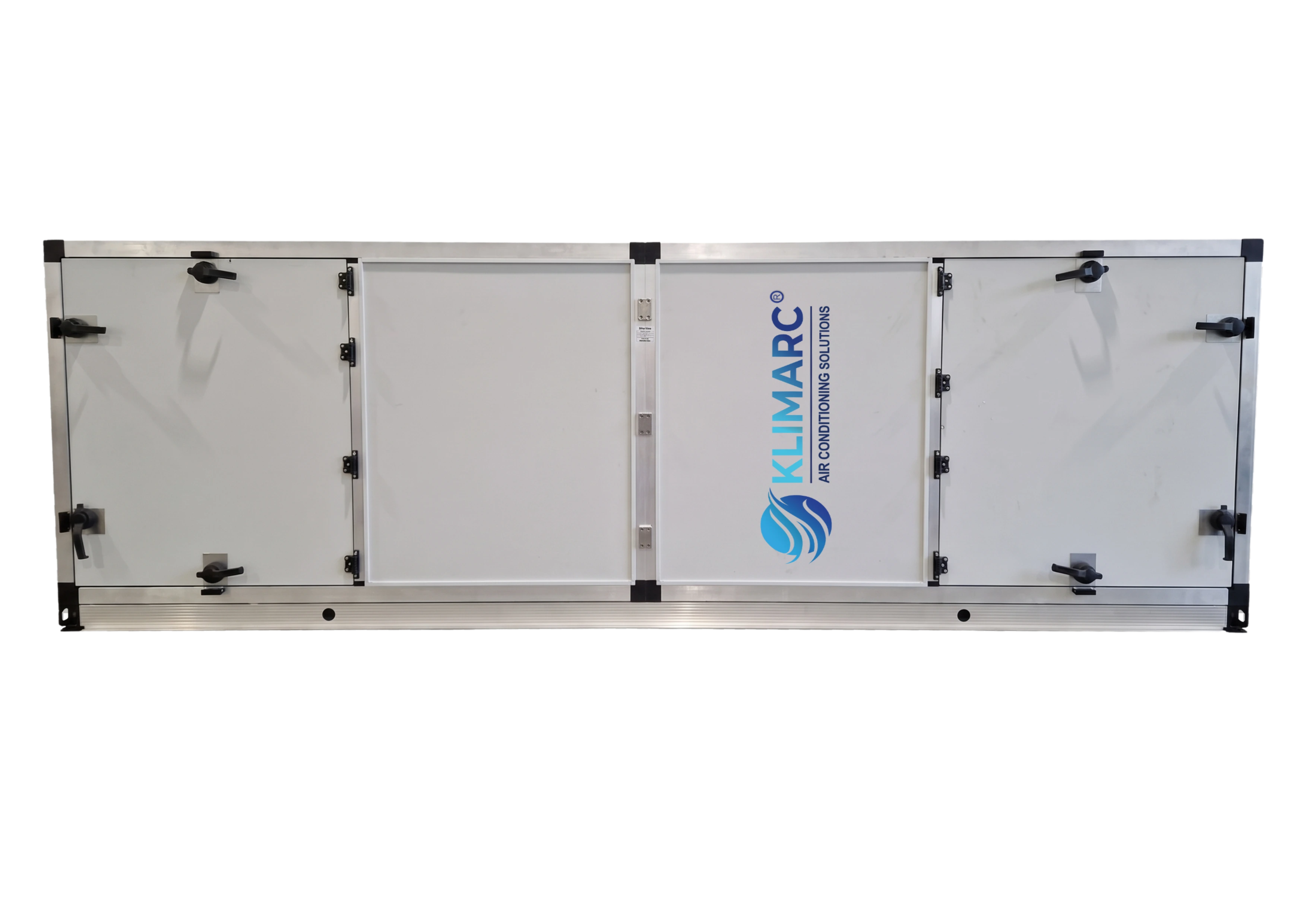
Unlike basic sheet-metal boxes that flex under fan suction and sweat in humid weather, KLIMARC ARC Ecology Units are built to the same robust standards as our Air Handling Units engineered in accordance with Eurovent EN 1886:
1. Double-Skin Insulated Casing
- 50 mm to 75 mm Rockwool Panels: High-density non-combustible rockwool (70 kg/m³, Class A1 fire rating) provides exceptional acoustic insulation, keeping fan noise inside the box while preventing exterior condensation in hot plantrooms.
- Smooth Internal Liners: Galvanized or AISI 304/316 stainless steel interior walls provide a smooth, wipe-clean surface for easy periodic maintenance and washdowns.
2. F400 Fire-Rated Exhaust Fans
In the event of a kitchen fire, the exhaust fan must continue operating to remove smoke and heat from the building:
- 400°C / 2-Hour Certified Fans: KLIMARC incorporates backward-curved centrifugal fans certified under EN 12101-3 to operate continuously at 400°C for 120 minutes during emergencies.
- Isolated Drive Motors: Fan motors are positioned out of the hot greasy airstream in a ventilated chamber, powered by Variable Frequency Drives (VFDs) that automatically adjust fan speed as filters accumulate dust.
3. Safety Interlocks & Smart BMS Integration
- Door Safety Microswitches: Instantly shut off high-voltage electricity to the ESP and discharge residual electrical charge whenever an inspection door is opened.
- Differential Pressure Monitoring: Pressure sensors across each filter stage alert building management when a filter needs washing or replacement before airflow drops.
- Fire Suppression Interlocks: Hardwired connections automatically turn off high-voltage ESP cells and UV lamps if the kitchen fire suppression system (such as ANSUL) triggers, while keeping the fire fan running in emergency exhaust mode.
6. Regulatory Standards & Upstream Canopy Synergy
Installing a certified Kitchen Ecology Unit is mandatory under regional and international building regulations:
- NFPA 96 & UAE Civil Defense: Mandates multi-stage grease and smoke removal for commercial kitchens discharging near sidewalks, balconies, or property lines.
- Municipal Environmental Regulations: Strictly enforces zero visible smoke discharge and zero nuisance odors at property boundaries.
Pairing Ecology Units with KVENT Hoods
To extend filter lifespan and keep interconnecting ductwork clean, MEP engineers pair Ecology Units with upstream KVENT kitchen hoods:
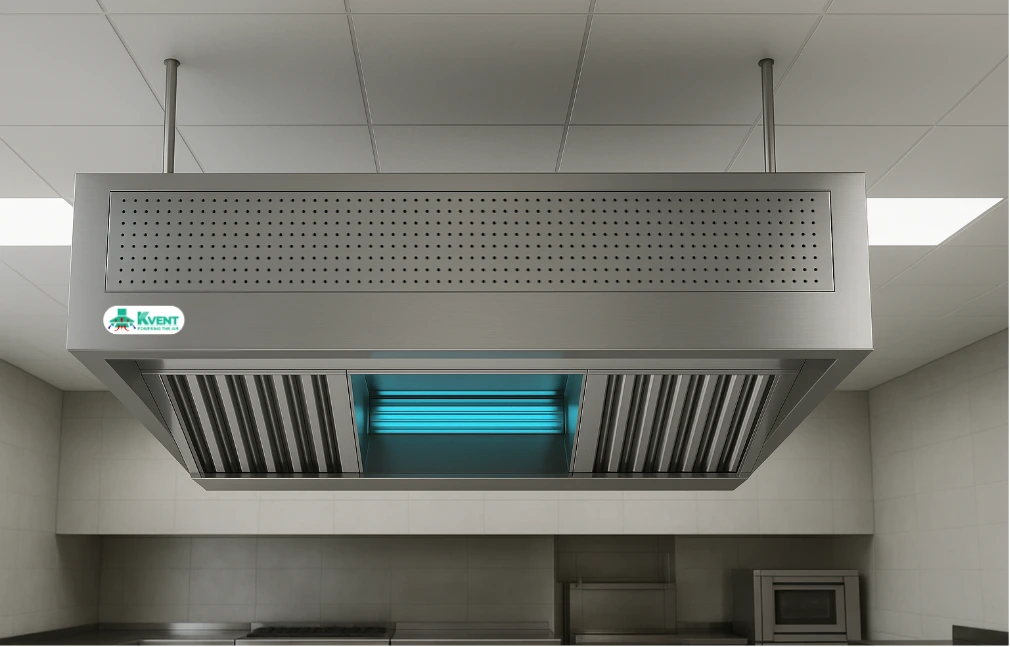
- KVENT UV-C Photolytic Hoods: Neutralize grease vapors at the cooking hood, keeping ductwork clean and doubling the time between required ESP cleanings.
- KVENT Water Mist Hoods & Aquafil Wet Scrubbers: Essential for charcoal grills and wood pizza ovens. Cold water mist curtains quench live sparks and cool hot exhaust air before it reaches the Ecology Unit, protecting the activated carbon filters from heat degradation.
7. Frequently Asked Engineering Questions (FAQ)
- Metal Pre-Filters: Washed every 1 to 2 weeks.
- ESP Collector Cells: Washed every 2 to 4 weeks (or daily/weekly using an automated wash-in-place system).
- Fine Bag Filters: Replaced every 3 to 6 months.
- Activated Carbon Canisters: Replaced or regenerated every 6 to 12 months depending on cooking volume.
Conclusion & Engineering Support
Specifying a KLIMARC ARC Kitchen Ecology Unit protects restaurant operators and building owners from grease fires, odor complaints, and municipal shutdowns. Manufactured in Ras Al Khaimah with double-skin rockwool panels, high-voltage ESP cells, deep-bed virgin activated carbon, and F400 fire-rated fans, KLIMARC delivers dependable, turnkey air pollution control.
To request airflow sizing schedules, carbon residence calculations, or Civil Defense submittal packages:
- Explore the complete KLIMARC Kitchen Ecology Unit Specifications
- Pair your systems with KVENT UV-C Kitchen Hoods, Water Mist Hoods, and Aquafil Wet Scrubbers
- View our complete range on the Commercial Kitchen Equipment Hub or review approvals on our Certifications Hub