In large commercial developments—such as airport terminals, hospitals, shopping malls, and university campuses—providing comfortable, healthy indoor air is a complex engineering challenge. This responsibility falls on Air Handling Units (AHUs) and Fresh Air Handling Units (FAHUs).
Choosing an AHU requires much more than simply matching a desired airflow volume (m³/h or CFM) against fan pressure. If a unit is selected using generic catalog assumptions designed for mild weather, buildings in hot and humid climates quickly suffer from three persistent problems:
- Uncontrolled Indoor Humidity: Cooling coils undersized for moisture removal leave indoor spaces cold and clammy (> 65% relative humidity), which leads to mold growth on walls and ceiling tiles.
- Casing "Sweating" (Condensation): Weak panel insulation causes the outside of the metal casing to drop below the ambient dew point, creating condensation puddles in plantrooms.
- High Electrical Bills: Outdated belt-driven fans waste substantial motor energy and require constant maintenance.
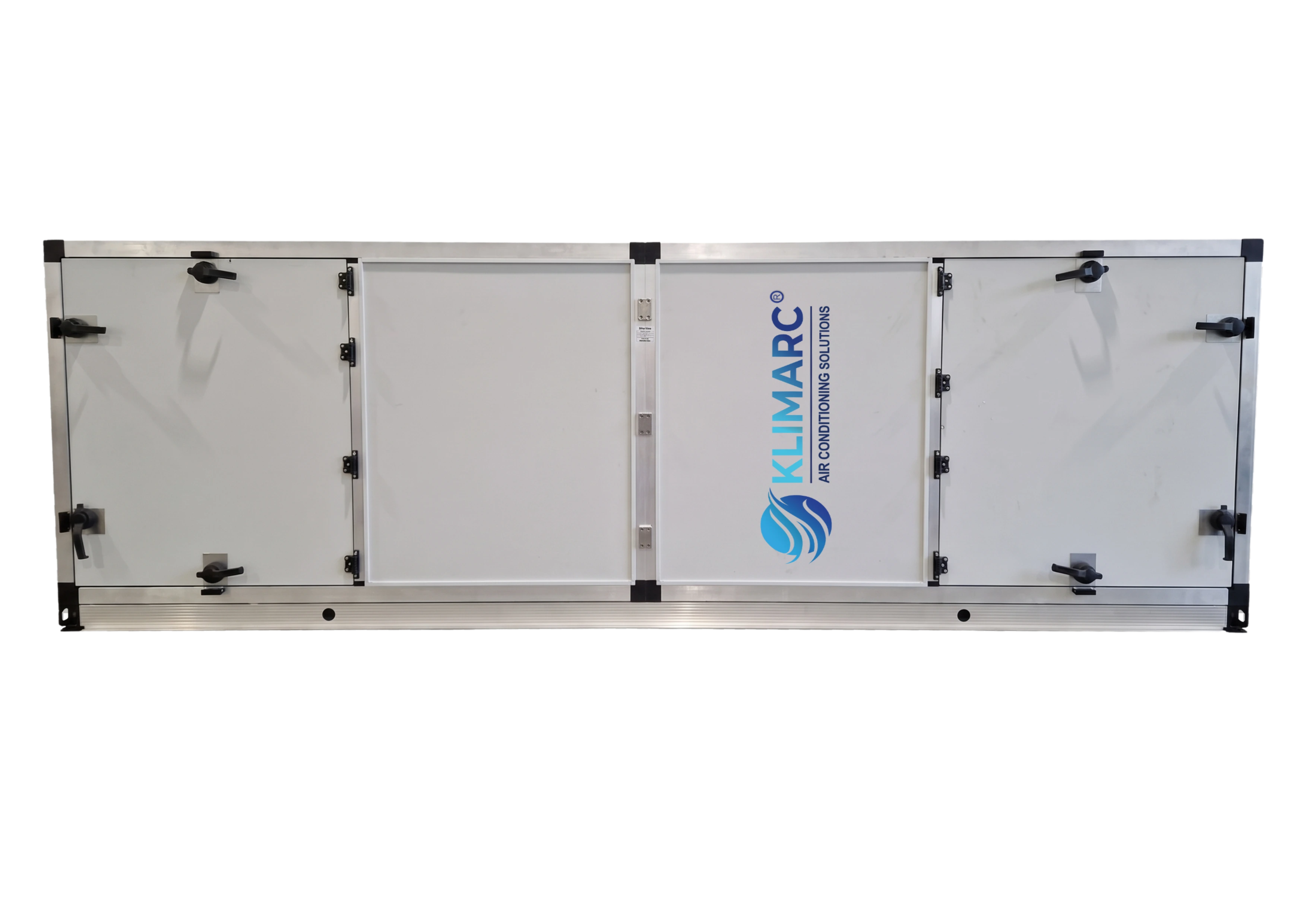
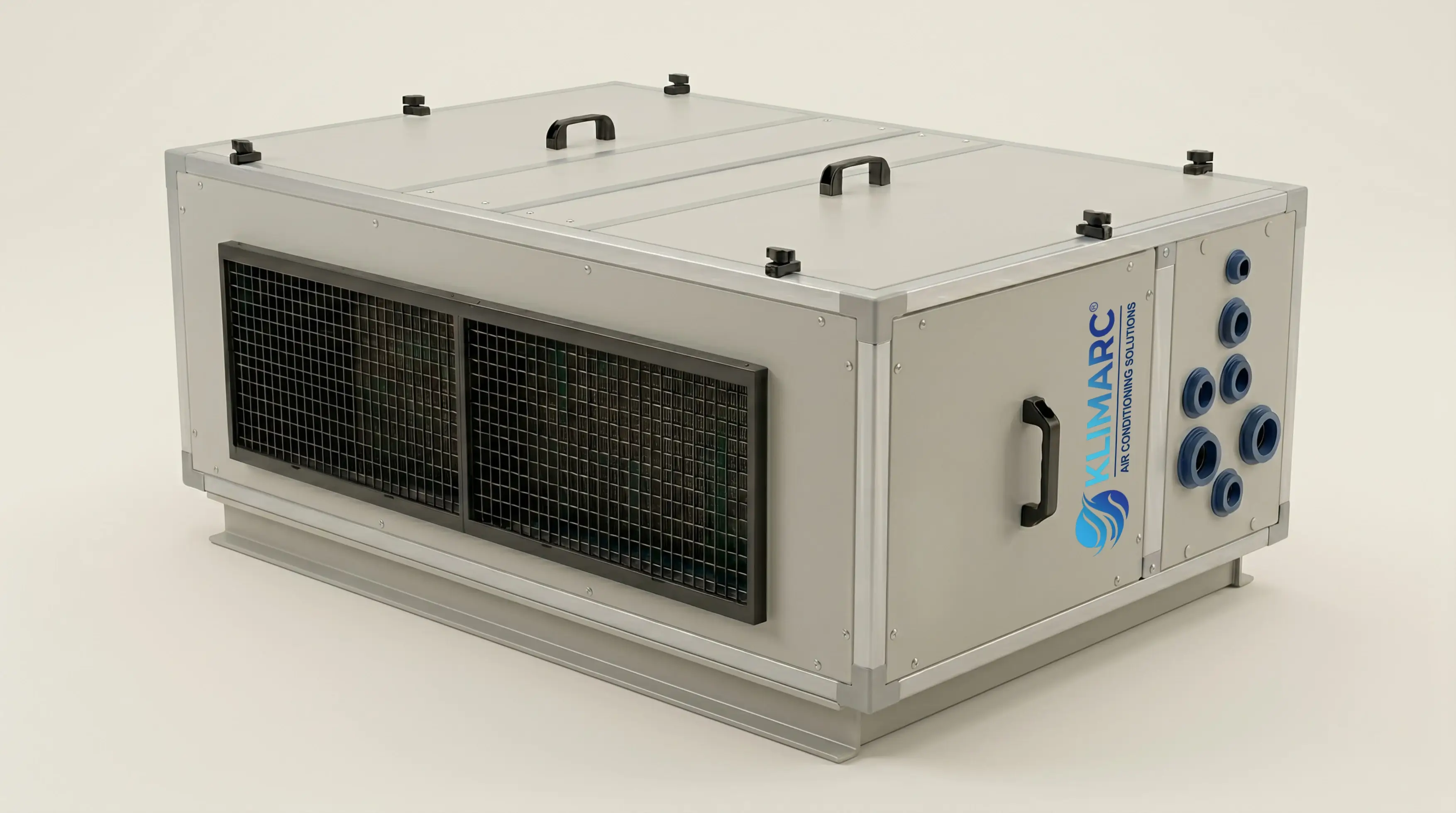
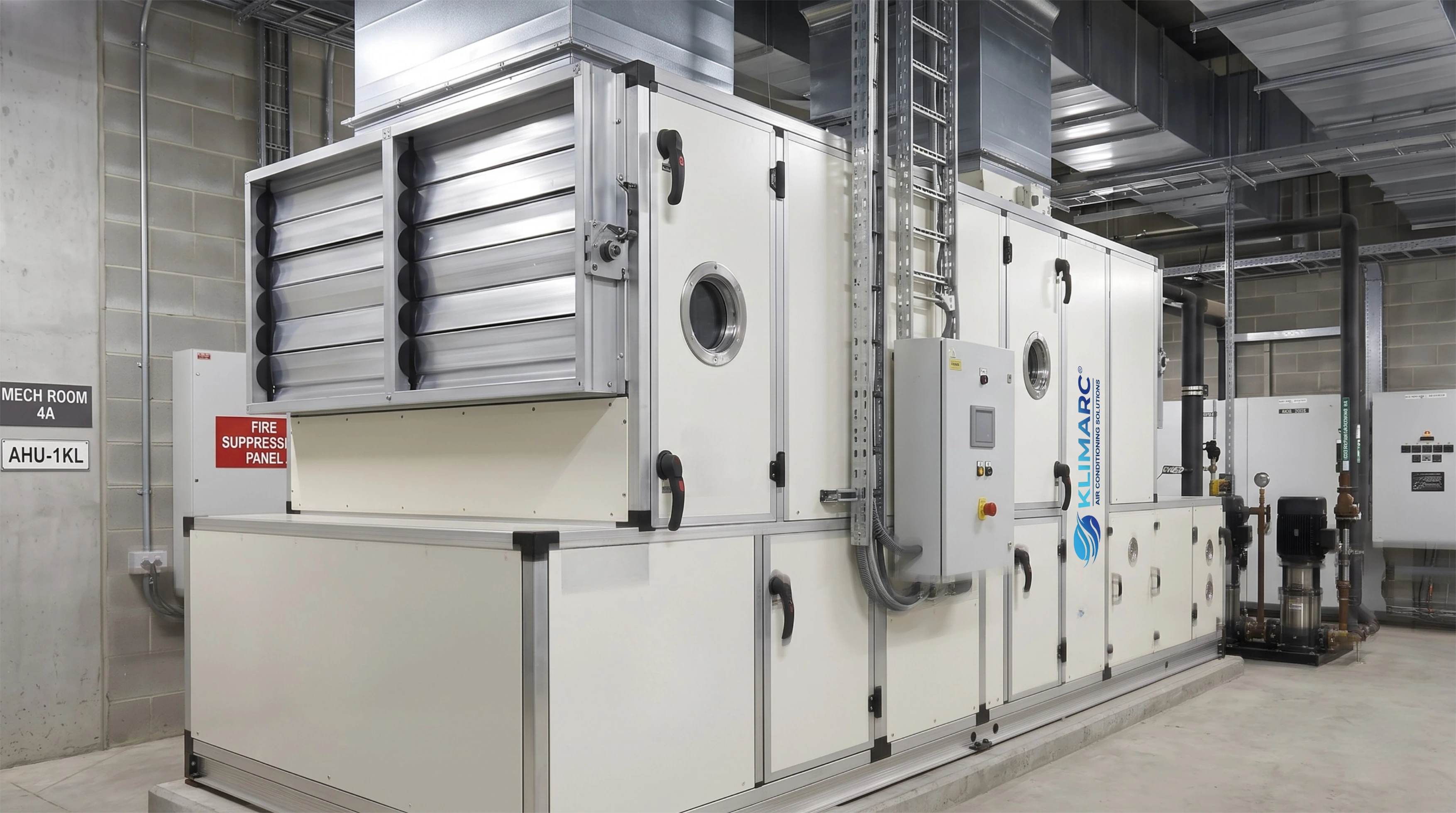
Manufactured in Ras Al Khaimah by Klima Air Conditioning Machines Manufacturing LLC, the KLIMARC ARC Series is engineered to conquer severe psychrometric moisture loads and extreme mechanical operating pressures.
- Casing Rigidity in Accordance with Eurovent EN 1886: Engineered in strict accordance with EN 1886 criteria for top-tier structural strength (Class D1), tight airtightness (Class L1), and high thermal bridging resistance (Class TB1/TB2) to eliminate casing sweating.
- High-Density 70 kg/m³ Rockwool Panels: 50 mm to 75 mm double-skin sandwich panels provide Class A1 non-combustible fire protection and dampen low-frequency fan rumble.
- AHRI 410 Certified Coils: Independently verified sensible cooling and deep latent dehumidification, tested under 30-bar pneumatic water immersion.
- Direct-Drive EC Plug Fan Walls: Zero-maintenance electronically commutated fans arranged in redundant arrays, paired with energy recovery wheels that reclaim up to 75% to 80% of exhaust energy.
1. Psychrometric Design: Sensible Cooling vs. Latent Dehumidification
The core thermodynamic purpose of an air handler is twofold: sensible cooling (lowering air temperature) and latent dehumidification (condensing moisture vapor into liquid water).
While dry desert climates experience primarily sensible heat loads (e.g. 48°C dry-bulb with low humidity), coastal cities experience intense latent moisture loads where ambient air carries more than 22 grams of water vapor per kilogram of dry air.
The Governing Psychrometric Equations
When sizing a cooling coil for a recirculating AHU or a 100% outdoor air Fresh Air Handling Unit (FAHU), the total cooling capacity (Qtotal) is the sum of sensible heat removal and latent moisture condensation:
Where ṁa is air mass flow rate (kg/s), cpm is the specific heat of moist air (~1.02 kJ/(kg·K)), hfg is the latent heat of vaporization of water (~2,450 kJ/kg), and ω is humidity ratio (kg of moisture per kg of dry air).
The Sensible Heat Ratio (SHR)
The Sensible Heat Ratio (SHR) measures what fraction of total cooling goes into lowering air temperature compared to condensing moisture:
- Standard Mixed-Air AHUs (SHR ≈ 0.75 to 0.85): These units recirculate indoor air, mixing in only 15% to 25% fresh air. Most of the cooling energy is used to lower air temperature, requiring standard 4-row to 6-row cooling coils.
- Dedicated Outdoor Air FAHUs (SHR ≈ 0.45 to 0.60): In hot, humid coastal climates, raw outdoor air has an extremely low SHR. More than 40% to 55% of the cooling coil's energy is spent solely on wringing water vapor out of the air. This requires deep 6-row, 8-row, or even 10-row cooling coils to ensure air stays in contact with cold fin surfaces long enough to condense moisture.
The "Oversizing Trap" & Wrap-Around Heat Pipes
A frequent design error is oversizing an AHU cooling coil as a "safety buffer." When an oversized unit runs, it satisfies the room thermostat quickly and shuts off before it has time to remove sufficient moisture. The building ends up feeling like a cold cave (21°C at 70% relative humidity), causing condensation to drip from supply air grilles.
To keep indoor humidity comfortably between 45% and 55% relative humidity, modern FAHUs use deep cooling coils to chill incoming air down to 12°C (condensing moisture out), paired with Wrap-Around (Horseshoe) Heat Pipes. The heat pipe precools warm incoming air before it hits the cooling coil, and then uses that absorbed heat to naturally reheat the air downstream to a comfortable 18°C–20°C—without using any extra electricity!
2. Eurovent EN 1886 Mechanical Casing Classifications
The structural and thermal quality of an AHU casing is evaluated under the European Standard EN 1886. KLIMARC units are custom-engineered in accordance with Eurovent EN 1886 casing guidelines, where five core parameters determine how well the casing will hold up:
| EN 1886 Parameter | Best Class (KLIMARC In Accordance with EN 1886) | Physical Test Limit | Why It Matters |
|---|---|---|---|
| 1. Casing Deflection (D) | Class D1 | ≤ 4.0 mm/m deflection at 1,000 Pa | Prevents panels from bulging or buckling under strong fan pressure, keeping doors and seals aligned. |
| 2. Casing Air Leakage (L) | Class L1 | ≤ 0.15 L/(s·m²) at −400 Pa & 0.22 at +700 Pa | Stops unconditioned hot, dusty air from being sucked in and prevents cooled air from escaping. |
| 3. Thermal Insulation (T) | Class T1 / T2 | U ≤ 0.5 to 1.0 W/(m²·K) | Stops summer heat from conducting through the outer casing into the chilled airstream. |
| 4. Thermal Bridging (TB) | Class TB1 / TB2 | kb ≥ 0.75 (TB1) or 0.60 to 0.74 (TB2) | Sweat Prevention: Keeps exterior metal surfaces warm enough to prevent condensation puddles. |
| 5. Filter Bypass Leakage (F) | Class F9 | ≤ 0.5% air bypass at +400 Pa | Forces virtually 100% of air through filters so fine dust cannot sneak around the edges. |
3. Thermal Breaks & Sweating Prevention: The Physics of kb
In hot, humid mechanical rooms and rooftops, the ambient dew point often reaches 31°C. Meanwhile, the supply air leaving the cooling coil inside the AHU is chilled to 12°C.
The Thermal Bridging Factor (kb) measures the coldest localized spot on the outside of the casing (usually along metal corner profiles, joints, and door latches):
The Sweat Prevention Rule: For the casing to stay completely dry, the minimum outside surface temperature (Tsurface,min) must stay strictly higher than the plantroom dew point:
Example Calculation (Plantroom at 40°C, 70% RH → Dew Point = 33.5°C):
- Standard Unit Without Thermal Breaks (Class TB4, kb = 0.40):
Tsurface,min = 12 + 0.40 × (40 − 12) = 23.2°C. Because 23.2°C is far below the 33.5°C dew point, the casing sweats heavily, dripping water onto the floor. - KLIMARC Thermal-Break AHU (Class TB1, kb = 0.78):
Tsurface,min = 12 + 0.78 × (40 − 12) = 33.8°C. Because 33.8°C is above the 33.5°C dew point, the casing stays completely dry.
KLIMARC achieves Class TB1 by inserting non-conductive polyamide composite strips between the inner and outer aluminum frames, physically blocking heat from traveling through the metal structure.
4. Direct-Drive EC Plug Fan Walls & Multi-Stage Air Filtration
Fans and filters account for more than 85% of an air handling unit's lifetime electrical costs. Modern building designs are rapidly replacing old belt-driven centrifugal fans with direct-drive Electronically Commutated (EC) Plug Fan Walls.
Why Direct-Drive EC Plug Fans Are Superior
- No Belts or Pulleys: Old belt-driven fans lose 5% to 12% of their energy to belt friction and slip. When a belt snaps, the entire building loses air conditioning. Direct-drive plug fans mount the fan wheel directly onto the motor shaft, eliminating belts, pulleys, and routine adjustments.
- Clean Air (Zero Belt Dust): As rubber belts wear down, they release black rubber dust into the airstream. Direct-drive fans eliminate belt dust entirely, which is vital for hospitals and cleanrooms.
- Built-in Redundancy (Fan Wall Arrays): Instead of one giant fan, modern AHUs use a grid of smaller EC plug fans running in parallel. If one motor fails, the remaining fans speed up automatically to maintain 100% of the building's airflow.
- Fan Affinity Energy Savings: Fan power consumption drops cubically with speed (Power ∝ RPM³). Slowing a fan down by just 20% during off-peak hours cuts its electrical power consumption by nearly 50%.
Multi-Stage Filtration Against Sandstorms
In regions subject to seasonal sandstorms, fine dust levels can overwhelm standard filters within days. KLIMARC uses a progressive multi-stage filtration system:
- Sand-Trap Louver & Washable Aluminum Mesh: Captures over 80% of coarse desert sand (> 20 µm) with self-draining chutes before air enters the unit.
- Pleated Pre-Filter (ISO Coarse 65% / G4): Catches medium dust particles to protect internal cooling coils and energy wheels.
- Fine Bag Filters (ISO ePM1 80% / F7–F9): Traps respirable fine dust, pollen, and bacteria.
- Terminal HEPA Filters (EN 1822 H13 / H14): Optional ultra-high efficiency filtration (99.95%+ efficiency) for hospital operating rooms and cleanrooms.
5. Regulatory Standards & Drain Pan Design
Modern air handlers must comply with rigorous sustainability and health standards:
- Green Building Standards (Dubai Al Sa'fat, Abu Dhabi Estidama, Saudi SBC 601): Limit Specific Fan Power (SFP ≤ 1.6 to 2.0 W/(L/s)) and require energy recovery wheels that reclaim up to 80% of energy from exhaust air.
- Hygienic Sloped Drain Pans (ASHRAE 62.1): Drain pans must be built from stainless steel (AISI 304 or 316) with a continuous slope toward the drain outlet to prevent standing water, mold, and bacterial growth.
- Proper Condensate Traps: Because cooling coils sit under negative air pressure from the fan suction, the drain pipe must have an appropriately tall P-trap filled with water. If the trap is too shallow, fan suction will pull air backward through the pipe, trapping water inside the pan until it overflows.
6. Frequently Asked Engineering Questions (FAQ)
Conclusion & Engineering Support
Specifying an Air Handling Unit requires a balance of psychrometric dehumidification, structural casing integrity, and fan energy efficiency. By combining EN 1886 Class D1/L1/T1/TB1 thermal-break construction built in accordance with Eurovent standards, 70 kg/m³ high-density rockwool, AHRI 410 certified coils, and direct-drive EC plug fan arrays, KLIMARC ARC Air Handling Units eliminate casing sweating, protect indoor air quality, and keep energy costs low.
To request custom coil selections, acoustic calculations, BIM models, or a fast technical submittal:
- Explore the KLIMARC ARC Air Handling Units (AHU) and Fresh Air Handling Units (FAHU)
- Pair your systems with KLIMARC Energy Recovery Ventilators (ERV) and AHRI-Certified Double-Skin FCUs
- Review our quality credentials on the KLIMARC Certifications Hub or download engineering guides from our Downloads Center