When engineers design air conditioning systems for commercial towers, hospitals, airports, and hotels, they often include a strict requirement in their equipment specifications:
“Air Handling Units (AHUs) shall be designed, manufactured, and tested in accordance with EN 1886, achieving minimum mechanical casing performance ratings of D1 (Deflection), L1 (Airtightness), T1/T2 (Thermal Insulation), TB1/TB2 (Thermal Bridging), and F9 (Filter Bypass Sealing).”
To someone reading this specification for the first time, this string of letters and numbers might look like arbitrary code. But in the world of heating, ventilation, and air conditioning (HVAC), each of these ratings represents a vital physical test.
In mild climates where outside air rarely climbs above 28°C, a low-grade casing might get by unnoticed. However, in extreme climates—such as the Middle East, where rooftop temperatures soar to 50°C (122°F) with intense coastal humidity—a weak AHU casing quickly causes three major failures:
- Exterior Sweating (Condensation): Chilled supply air (11°C to 13°C) inside the unit cools down the outer metal casing. When this cold surface touches hot, humid plantroom air, water condenses continuously, flooding mechanical room floors with puddles and encouraging mold growth.
- Panel Bulging & Door Jamming: High-powered fans generate intense internal air pressures (often ±1,000 Pa). Weak panels bow inward or outward, warping access doors and breaking air seals.
- Energy Bleed & Dust Infiltration: Unsealed joints leak expensive chilled air out into the plantroom on the pressure side, while sucking hot, dusty outdoor air directly into the unit on the suction side—bypassing air filters entirely.
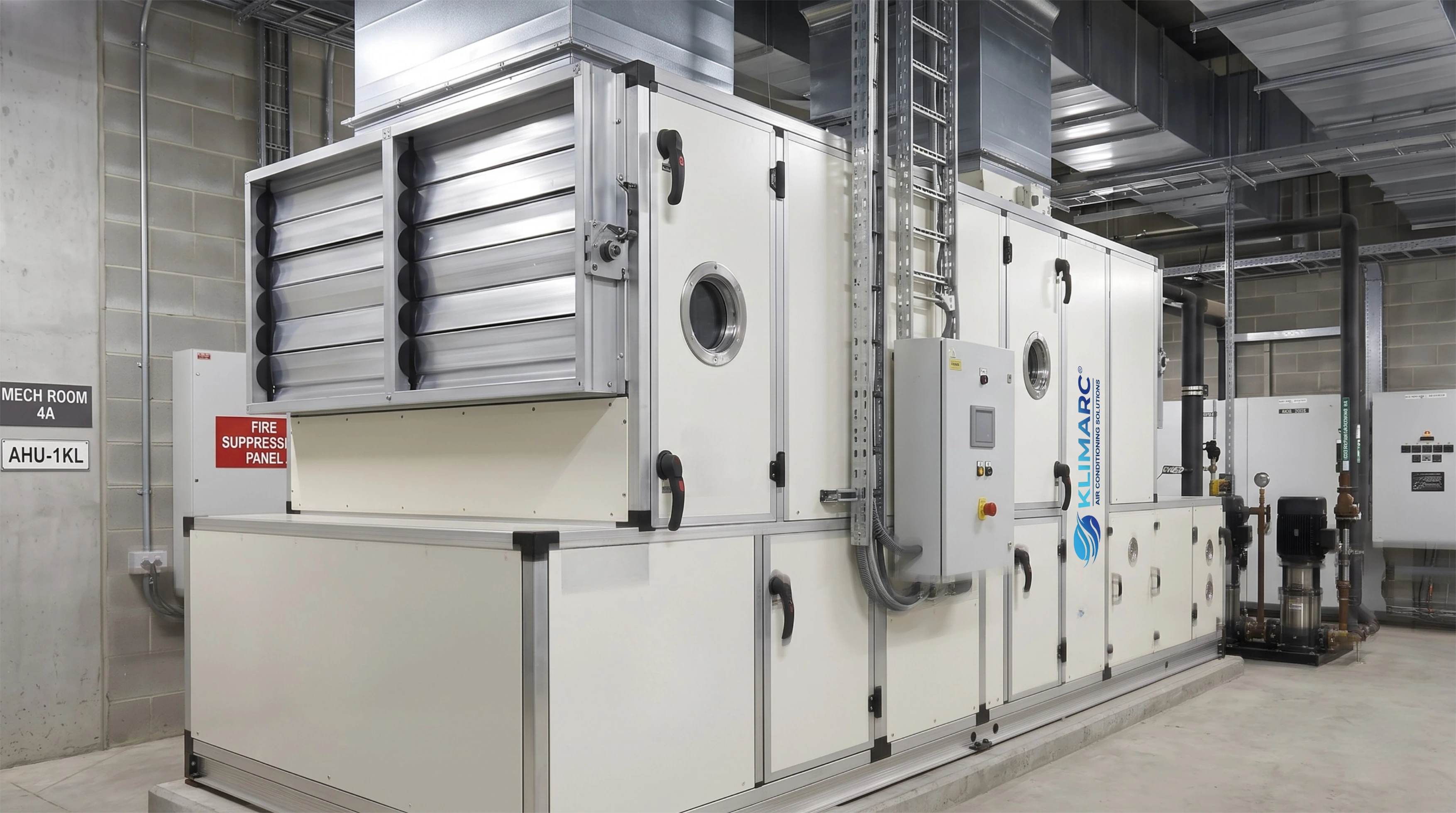
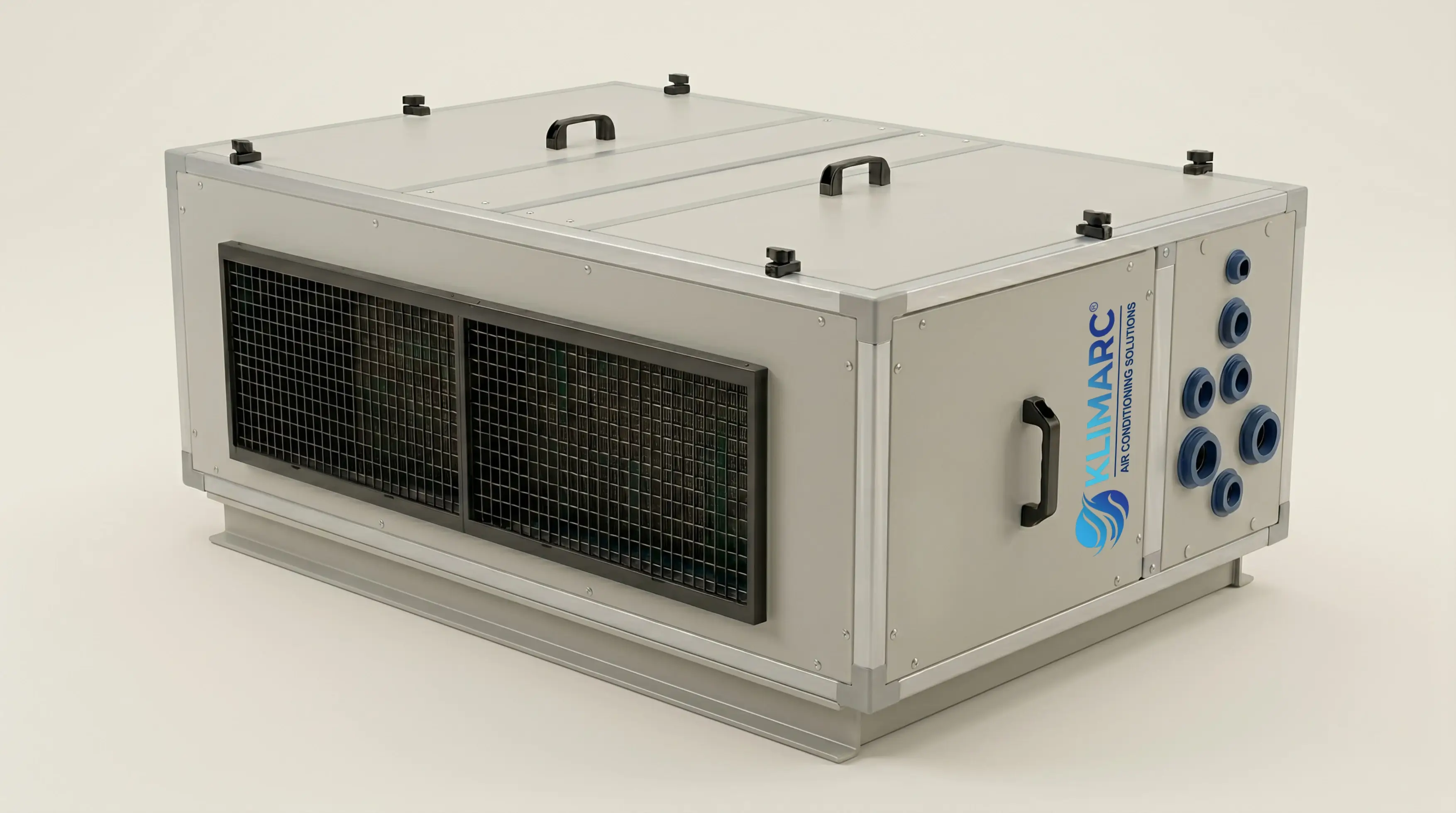
Manufactured in Ras Al Khaimah by Klima Air Conditioning Machines Manufacturing LLC, the KLIMARC ARC Air Handling Unit Series is engineered and custom-built in strict accordance with Eurovent EN 1886 standards to achieve all five mechanical casing benchmarks.
KLIMARC air handling systems are manufactured in Ras Al Khaimah, UAE, and engineered in strict accordance with Eurovent EN 1886 casing mechanical performance criteria (Classes D1 / L1 / T1–T2 / TB1–TB2 / F9). While our cooling and heating coils carry official third-party AHRI 410 Certification and our manufacturing facility operates under certified ISO 9001, 14001, and 45001 quality and management systems, KLIMARC AHU casings are designed, built, and tested in accordance with Eurovent EN 1886 standards rather than holding an individual Eurovent product certificate at this time.
- Mechanical Deflection (Class D1): The highest structural stiffness rating. Casing panels flex less than 4 mm per meter under ±1,000 Pa static pressure, with zero permanent bending after a 1,500 Pa stress test.
- Casing Airtightness (Class L1): The tightest sealing standard. Limits air leakage to under 0.15 L/(s·m²) under suction and 0.22 L/(s·m²) under positive pressure, using precision CNC laser-cut panels and air-cushion rubber gaskets.
- Filter Bypass Sealing (Class F9): Ensures less than 0.5% of air can sneak around the edges of the filter rack, forcing virtually 100% of air through the filter media to capture fine desert dust.
- Thermal Envelope (Classes T1/T2 & TB1/TB2): 50 mm to 75 mm double-skin sandwich panels packed with dense rockwool insulation (70 kg/m³) and polyamide thermal breaks to eliminate exterior sweating and stop heat from conducting into chilled air.
1. What Is EN 1886 Model-Box Testing & Why It Matters
A common misunderstanding is that EN 1886 ratings are simple math formulas calculated on a computer. In reality, EN 1886 (Ventilation for buildings — Air handling units — Mechanical performance) is an exacting physical laboratory test standard.
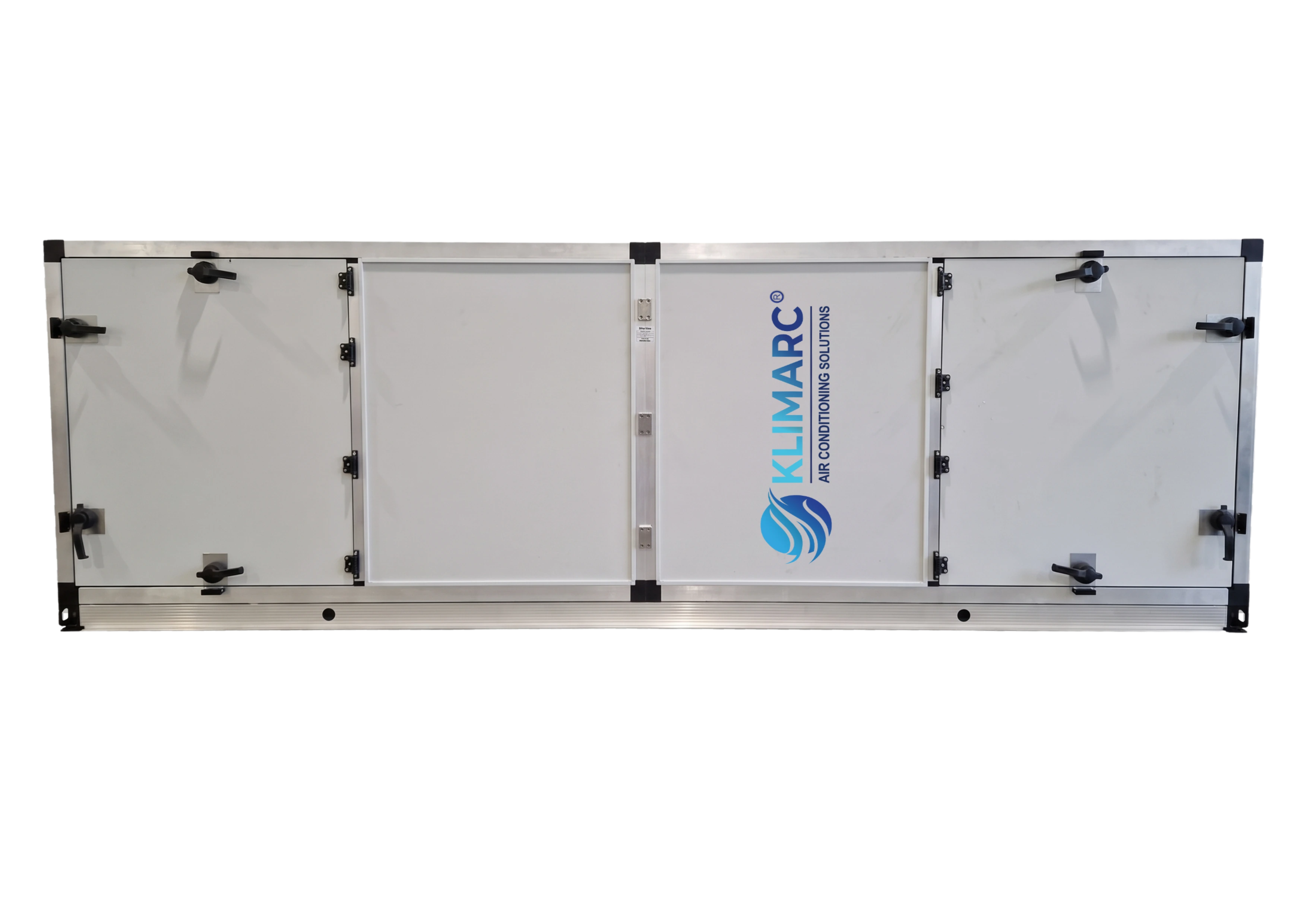
Under this European standard, a manufacturer cannot simply test a standalone piece of foam insulation in a press. Instead, an independent laboratory tests an entire assembled AHU Model Box that incorporates all the real-world structural challenges of an operating air handler:
- Aluminum corner pentapost frames and structural mullions
- Interlocking double-skin removable and fixed access panels
- Hinged inspection doors, heavy-duty compression handles, and viewing portholes
- Internal filter mounting tracks and perimeter compression gaskets
By subjecting this complete physical box to extreme positive/negative air pressures and a steep thermal gradient (ΔT ≥ 20°C) inside a climate chamber, EN 1886 exposes any weak joints, air leaks, or thermal short-circuits before equipment ever ships to a jobsite.
The Complete EN 1886 Classification Matrix
| EN 1886 Test Parameter | Class 1 (Best / Elite) | Class 2 (Commercial Standard) | Class 3 (Basic / Low) | KLIMARC ARC Standard (In Accordance with EN 1886) |
|---|---|---|---|---|
| 1. Casing Deflection (D) at 1,000 Pa | D1 (≤ 4.0 mm/m) | D2 (≤ 10.0 mm/m) | D3 (> 10.0 mm/m) | Class D1 |
| 2. Air Leakage (L) at −400 / +700 Pa | L1 (0.15 / 0.22 L/(s·m²)) | L2 (0.44 / 0.63 L/(s·m²)) | L3 (1.32 / 1.90 L/(s·m²)) | Class L1 |
| 3. Filter Bypass Leakage (F) at +400 Pa | F9 (≤ 0.5% flow) | F8 (≤ 1.0% flow) | F7 (≤ 2.0% flow) | Class F9 |
| 4. Thermal Transmittance (U-Value) | T1 (U ≤ 0.5 W/(m²·K)) | T2 (0.5 < U ≤ 1.0) | T3 (1.0 < U ≤ 1.4) | Class T1 / T2 |
| 5. Thermal Bridging Factor (kb) | TB1 (0.75 ≤ kb ≤ 1.0) | TB2 (0.60 ≤ kb < 0.75) | TB3 (0.45 ≤ kb < 0.60) | Class TB1 / TB2 |
2. Casing Strength & Structural Deflection: Class D1 vs. D2/D3
Large commercial buildings rely on powerful fans to push air through long ductwork runs, multi-stage air filters, and heat recovery wheels. These fans generate substantial internal static pressures—often between 800 Pa and 1,400 Pa (equivalent to the force of strong storm-force winds acting against the panels from the inside).
Under EN 1886, mechanical strength is measured as the deflection (Δd) per meter of panel span (L) under a test pressure of ±1,000 Pa:
Here is how different classes behave under real operating pressures:
- Class D1 (≤ 4.0 mm/m): The gold standard. Under ±1,000 Pa pressure, a 1-meter panel flexes less than 4 mm. The test also includes an overpressure safety check at +1,500 Pa (1.5 times design pressure) to confirm that panels return to their exact original shape with zero permanent deformation.
- Why Class D2 (≤ 10 mm/m) and Class D3 (> 10 mm/m) Fail: If a 1.5-meter panel flexes by 15 mm or more under suction, the panel edges pull away from their rubber perimeter seals. Doors stick or refuse to close properly, latches become dangerous to open under pressure, and internal filter racks warp, letting dirty air bypass the filters.
How KLIMARC Engineers Class D1 Rigidity
To achieve Class D1 stiffness, KLIMARC ARC AHUs combine heavy-gauge double-skin sheet metal (0.8 mm to 2.0 mm outer and inner skins of galvanized steel, Aluzinc, or stainless steel) interlocked into rigid extruded aluminum pentapost frame profiles and mounted on heavy-duty structural steel base channels.
3. Casing Air Leakage: Class L1 Airtightness & Precision Manufacturing
Air leaks in an AHU casing waste energy and compromise indoor air quality in two distinct ways:
- Suction-Side Infiltration (Negative Pressure): Before the supply fan (around the cooling coils and filters), negative pressure pulls outside plantroom air in through unsealed panel seams. In hot climates, this draws humid 48°C air directly into the unit, forcing the cooling coil to work harder and bypassing the pre-filters.
- Discharge-Side Exfiltration (Positive Pressure): After the supply fan, positive pressure pushes expensive 12°C chilled air out of the casing into the unoccupied plantroom before it ever reaches building occupants.
The Air Leakage Equation
EN 1886 calculates leakage rate normalized over the total outer casing area (Acasing in m²) at two standard test pressures: −400 Pa (suction) and +700 Pa (discharge):
Under this formula:
- Class L1 (Elite): Maximum allowable leakage is strictly capped at 0.15 L/(s·m²) under −400 Pa and 0.22 L/(s·m²) under +700 Pa.
- The High Cost of L2 and L3: A Class L2 casing leaks 3 times more air than an L1 casing. A Class L3 casing leaks nearly 9 times more air, wasting thousands of dollars in fan electrical power every year.
KLIMARC achieves Class L1 airtightness through automated CNC fiber laser cutting (0.05 mm tolerances) and continuous extruded EPDM rubber gaskets with hollow internal air cushions that elastically expand to seal every seam under pressure.
4. Filter Bypass Leakage: Class F9 Sealing Against Desert Dust
Specifying high-efficiency air filters (such as ISO 16890 ePM1 bag filters or HEPA filters) is useless if air can simply slip around the edges of the filter rack.
During regional sandstorms, outdoor dust levels can spike dramatically. Because air naturally follows the path of least aerodynamic resistance, even a 2 mm gap around a filter frame acts like an open highway for fine silica dust and mold spores. The uncleaned air fouls the cooling coil fins and contaminates clean rooms, hotels, and hospital wards.
EN 1886 Filter Bypass Limits (Tested at +400 Pa)
- Class F9 (KLIMARC Standard): Filter bypass leakage must not exceed 0.5% of design airflow. More than 99.5% of all air is forced through the filter media.
- Class F8: Allows up to 1.0% bypass leakage.
- Class F7: Allows up to 2.0% bypass leakage (four times more dust bypass than Class F9).
KLIMARC achieves Class F9 sealing using CNC-punched universal filter frames with stainless steel spring-compression clips and closed-cell perimeter gaskets that clamp the filter tightly against the frame.
5. Thermal Transmittance (Class T1/T2) & Acoustic Sound Dampening
When an Air Handling Unit or Fresh Air Handling Unit (FAHU) sits on an exposed rooftop in summer, solar radiation can heat surrounding rooftop surfaces above 60°C. Meanwhile, the air inside the unit is chilled to 12°C. That creates a massive temperature difference (ΔT ≈ 40°C to 50°C) trying to push heat straight through the casing walls.
Heat Gain Through the Casing (U-Value)
The rate of heat conduction through the casing panels (in Watts) is governed by the panel's Thermal Transmittance (U-value):
A lower U-value means better thermal insulation:
- Class T1: U ≤ 0.5 W/(m²·K) — Superior thermal insulation.
- Class T2: 0.5 < U ≤ 1.0 W/(m²·K) — Standard commercial high-grade insulation.
- Class T3 / T4: U > 1.0 W/(m²·K) — Poor insulation that conducts significant unwanted heat into chilled air.
High-Density Rockwool vs. Polyurethane Foam (PUF)
KLIMARC manufactures double-skin panels in both 50 mm and 75 mm thicknesses with two core insulation choices:
- 70 kg/m³ Mineral Rockwool (Consultant Favorite): Delivers Class T1/T2 thermal performance alongside Class A1 non-combustible fire safety (zero smoke or toxic fumes) and superior acoustic dampening. Its heavy density absorbs low-frequency fan rumble (125 Hz to 250 Hz) far better than lightweight foam.
- 40–42 kg/m³ Injected Polyurethane Foam (PUF): Closed-cell foam with very low thermal conductivity (λ ≈ 0.022 W/(m·K)), ideal for maximum thermal insulation in compact dimensions.
6. Thermal Bridging Factor (Class TB1/TB2): The Science of Zero Sweating
While the U-value measures overall heat conduction through the center of an insulated panel, the Thermal Bridging Factor (kb) measures the coldest localized spot on the outside of the casing—typically along metal corner posts, panel seams, door hinges, and handle penetrations.
A "thermal bridge" is like an uninsulated highway for heat. Because aluminum and steel conduct heat thousands of times faster than rockwool insulation, any direct metal-to-metal contact between the inner cold skin and the outer warm skin causes the exterior metal to become ice-cold.
The Thermal Bridging Equation (kb)
The dimensionless Thermal Bridging Factor (kb) compares the temperature of the coldest spot on the outside casing to the ambient temperature:
Rearranging this formula lets engineers calculate the exact minimum exterior surface temperature (Tmin,ext):
The Rule for Zero Sweating: To prevent condensation, the exterior surface temperature must stay higher than the plantroom's Dew-Point Temperature (Tdp):
Real-World Plantroom Example (Ambient = 40°C, 70% RH, Chilled Air = 12°C)
In an unconditioned mechanical plantroom in August with 40°C air and 70% relative humidity, the psychrometric dew point is 33.5°C. That means any surface cooler than 33.5°C will start sweating immediately.
| Thermal Bridge Class | kb Rating Range | Calculated Outer Surface Temp (Tmin,ext) | Condensation Result (Dew Point = 33.5°C) |
|---|---|---|---|
| Class TB1 (Elite) | kb ≥ 0.75 (e.g., 0.80) | 34.4°C | ZERO SWEATING (Surface stays dry) |
| Class TB2 (Commercial High) | 0.60 ≤ kb < 0.75 (e.g., 0.68) | 31.0°C | Safe up to 62% plantroom humidity |
| Class TB3 (Basic) | 0.45 ≤ kb < 0.60 (e.g., 0.50) | 26.0°C | SEVERE SWEATING (7.5°C below dew point) |
| Class TB4 / TB5 (Poor) | kb < 0.45 (e.g., 0.35) | 21.8°C | CATASTROPHIC SWEATING (Drips puddles onto the floor) |
As the table demonstrates, a cheap Class TB3 or TB4 unit without proper thermal breaks drops its frame temperature down to 21.8°C–26.0°C—nearly 12°C below the dew point. The casing acts like an unintentional dehumidifier, dripping water onto the floor. KLIMARC eliminates this by inserting high-performance polyamide thermal breaks between the inner and outer aluminum frames, physically severing the thermal bridge and keeping the outer frame warm and dry.
7. Green Building Compliance & Engineering Submittal Checklist
Specifying EN 1886 (D1 / L1 / T1–T2 / TB1–TB2 / F9) aligns directly with major sustainability standards:
- Dubai Municipality (Al Sa'fat) & Abu Dhabi (Estidama): Requires verified Class L1 airtightness to eliminate energy waste, condensation protection (TB1/TB2), and high-efficiency Energy Recovery Ventilators (ERV).
- Saudi Arabia (SBC 501 / SBC 601): Mandates rigorous thermal transmittance, Class A1 fire-safe non-combustible rockwool, and AHRI 410 certified coils for major developments.
- Qatar GSAS & Kuwait MEW: Require verified Class D1 mechanical deflection and Class L1 leakage for extreme high-ambient reliability.
5-Point Submittal Checklist for Engineers
- Confirm Model-Box Testing in Accordance with EN 1886: Verify that D1/L1/T1/TB1 ratings are supported by physical model-box test reports conducted in accordance with EN 1886 standards, rather than unverified computer estimations.
- Check Insulation Density and Fire Rating: Confirm panels use 70 kg/m³ non-combustible rockwool (Class A1) rather than loose glass fiber that settles over time.
- Inspect Door and Handle Thermal Breaks: Ensure door hinges, latches, and observation windows feature thermal breaks to avoid local condensation spots.
- Review Perimeter Gaskets: Require continuous extruded EPDM rubber gaskets with internal air cushions rather than adhesive foam strips.
- Pair Casing with Certified Internal Components: Ensure cooling coils carry AHRI 410 Certification and fans utilize direct-drive EC plug fan arrays.
8. Frequently Asked Engineering Questions (FAQ)
- Exposed Coastal Rooftops: Where units endure intense solar heating and high humidity, demanding maximum Class T1 / TB1 insulation against condensation and heat gain.
- Noise-Sensitive Indoor Plantrooms: In hospitals, hotels, and performing arts centers where plantrooms border quiet spaces, 75 mm high-density rockwool panels provide superior low-frequency sound dampening.
Conclusion & Engineering Support
Specifying EN 1886 (D1 / L1 / T1–T2 / TB1–TB2 / F9) is the most reliable way to protect buildings from casing condensation, air leakage, and wasted chiller electricity. Built in Ras Al Khaimah with 50 mm to 75 mm high-density rockwool panels, polyamide thermal breaks, and air-cushion EPDM gaskets, KLIMARC ARC Air Handling Units are manufactured in strict accordance with Eurovent EN 1886 standards to deliver verified structural strength and thermal performance.
To request an EN 1886 submittal schedule, dew-point condensation analysis, BIM/Revit models, or to arrange a factory inspection:
- Explore the KLIMARC ARC Air Handling Units (AHU) and Fresh Air Handling Units (FAHU)
- Pair your air handlers with KLIMARC Energy Recovery Ventilators (ERV) and AHRI-Certified Double-Skin FCUs
- Review our ISO and AHRI credentials on the KLIMARC Certifications Hub or download documents from our Downloads Center