In high-volume commercial kitchens—such as hotel banquet facilities, busy steakhouses, burger grills, and Asian wok restaurants—airborne cooking grease is a major fire hazard and maintenance burden.
While standard kitchen canopies look like they are working, conventional stainless steel baffle filters only catch large, heavy grease spatters—typically only 30% to 45% of the total grease emitted. The remaining 55% to 70% consists of microscopic grease aerosols, oil mists, and volatile vapors that pass right through the filter blades into the exhaust ductwork.
Over weeks of heavy cooking, these oily vapors cool down and condense along the inside of vertical exhaust shafts, creating a thick layer of flammable sludge. If a flame flares up on a cooking range, it can ignite this oil layer, turning the building's exhaust duct into a dangerous vertical chimney fire. KVENT UV-C Kitchen Exhaust Hoods, manufactured in Ras Al Khaimah by Klima Air Conditioning Machines Manufacturing LLC, eliminate this grease at the cooking canopy using the chemistry of Photolytic Oxidation and Ozonolysis.
- UV Photolysis (254 nm): High-energy ultraviolet light snaps long-chain grease and fat molecules (triglycerides) into smaller, highly reactive fragments.
- Vacuum UV Ozonolysis (185 nm): Ultraviolet light at 185 nm splits oxygen molecules in the air to create ozone (O3) and hydroxyl radicals (·OH), which react with the broken grease fragments in a "cold combustion" reaction.
- Harmless Reaction Products: The grease is chemically transformed into carbon dioxide (CO2), water vapor, and a tiny amount of dry, non-flammable mineral dust that cannot burn.
- Fire Safety Compliance (NFPA 96): Eliminates flammable grease sludge from building ducts, dramatically reducing the risk of fires and cutting duct-cleaning costs by up to 80%.
1. The Sub-Micron Grease Dilemma in Commercial Kitchens
To understand why standard kitchen hoods fail to keep ducts clean, we need to examine what happens to cooking oils under high heat. When vegetable oils or animal fats reach their smoke points (185°C to 235°C), they thermally break down and vaporize into three distinct sizes:
Particle Size Spectrum in Cooking Fumes
- Large Liquid Droplets (> 10 µm): Heavy oil splatters from frying. Standard metal baffle filters catch these through inertial impaction: heavy droplets have enough mass and momentum to hit the baffle blades and drain into grease cups.
- Fine Grease Aerosols (0.1 µm to 3.0 µm): Condensed oil mists and smoke particles. These microscopic particles are so light that they float along with air streamlines, curving effortlessly around metal filter blades and entering the ductwork.
- Gaseous Odors (< 0.1 µm): Volatile organic compounds (VOCs) that give off pungent cooking smells. These are individual gas molecules that cannot be stopped by any mesh or baffle filter.
As hot exhaust fumes (45°C to 70°C) travel away from the cooking stove into cooler ceiling ducts, their temperature drops below the condensation point of the oil vapors. The oil turns back into liquid, coating duct seams, turning vanes, fire dampers, and exhaust fans with a sticky, flammable fuel layer.
Under international fire codes like NFPA 96 (Standard for Ventilation Control and Fire Protection of Commercial Cooking Operations), grease buildup exceeding just 50 to 100 micrometers is considered a severe fire hazard that requires immediate manual scraping and chemical cleaning.
2. The Chemistry of Dual-Wavelength Photolysis & Ozonolysis
A common point of confusion is mistaking standard germicidal UV-C lamps (used in Air Handling Units for killing bacteria) for commercial kitchen UV systems. Standard germicidal lamps emit only at 254 nm and are designed not to produce ozone. While that works for killing germs, it cannot break down fast-moving, heavy kitchen grease vapors.
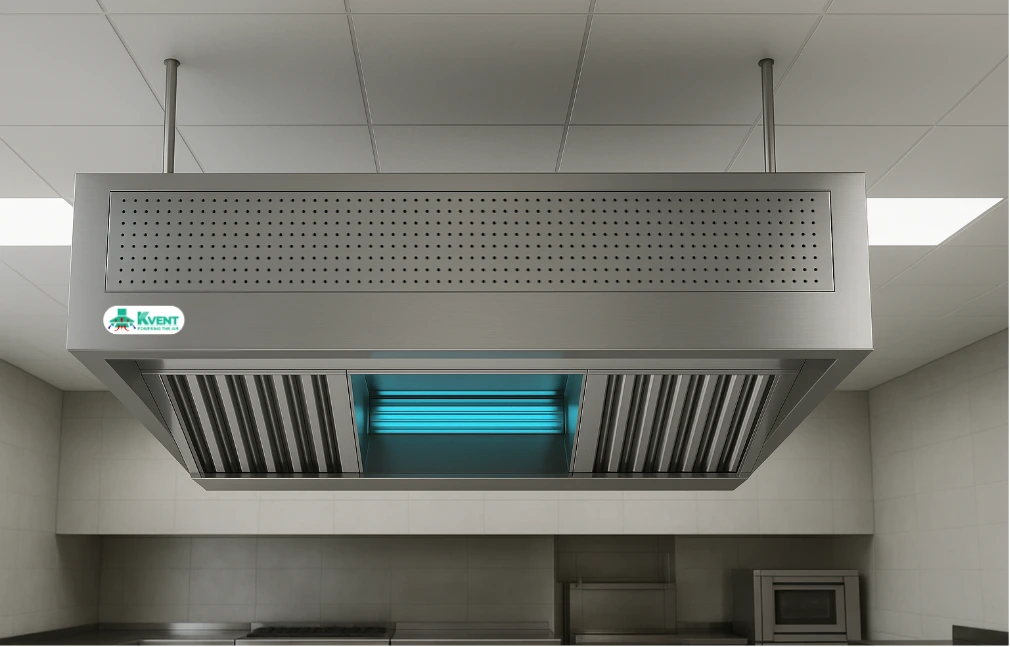
KVENT UV-C Kitchen Hoods use specialized synthetic quartz lamps mounted inside the hood plenum directly behind the primary baffle filters. These lamps emit two distinct ultraviolet wavelengths simultaneously:
Phase A: Direct Photolysis (254 nm Ultraviolet Cleavage)
Cooking fats consist of triglycerides—long hydrocarbon chains held together by strong carbon-carbon (C–C) and carbon-hydrogen (C–H) chemical bonds.
When grease vapor passes through the intense 254 nm ultraviolet field inside the hood, high-energy UV photons bombard the hydrocarbon chains. The photon energy exceeds the bond strength of the molecules, snapping long fat chains into smaller, highly reactive organic pieces called free radicals:
Phase B: Vacuum UV Ozonolysis (185 nm "Cold Combustion")
Simultaneously, the synthetic quartz lamp envelope transmits shorter-wavelength vacuum UV light at 185 nm. These energetic photons split diatomic oxygen molecules (O2) in the exhaust air into free oxygen atoms (O·). These free oxygen atoms quickly bond with surrounding oxygen molecules to create ozone (O3) and react with ambient moisture to produce hydroxyl radicals (·OH):
Phase C: Chemical Reaction in the Exhaust Duct
While photolysis happens directly in line-of-sight of the lamps, ozonolysis continues downstream as the air flows through the ductwork. Ozone (O3) and hydroxyl radicals (·OH) mix thoroughly with the shattered grease fragments, driving a rapid "cold combustion" oxidation reaction:
Instead of condensing into thick, sticky, flammable liquid grease, the cooking oils are chemically converted into harmless carbon dioxide gas, trace water vapor, and a microscopic, dry white mineral dust. This powder is completely non-sticky, non-combustible, and simply sweeps out with the exhaust air or washes away during routine annual maintenance.
3. Primary Pre-Filtration & Airflow Residence Time
A UV-C kitchen hood relies on proper mechanical pre-filtration. If large liquid oil droplets hit the hot quartz glass of the UV lamps, the oil will bake into a dark brown crust. Even a paper-thin film of baked grease blocks up to 90% of UV light, rendering the lamps ineffective.
To ensure the lamps stay clean and work at peak efficiency, KVENT UV-C Hoods incorporate three engineering safeguards:
- High-Efficiency Centrifugal Baffle Filters: Before air reaches the UV lamps, it passes through heavy-duty stainless steel baffle or cyclonic filters. These maintain an optimal air velocity (4.5 to 6.0 m/s), centrifuging out over 90% of liquid droplets larger than 8 µm into a sloped drainage trough.
- Reflective Stainless Steel Chamber: The UV lamp cassettes sit in a chamber lined with brushed AISI 304/316 stainless steel. The reflective surfaces bounce UV light in all directions, ensuring every cubic inch of moving air receives maximum ultraviolet exposure.
- Aerodynamic Residence Time (1.5 to 2.0 Seconds): For ozone to completely oxidize volatile grease and odors, the air needs approximately 1.5 to 2.0 seconds of travel time inside the duct. At standard kitchen duct airspeeds (7.5 to 9.0 m/s), this corresponds to about 12 to 18 meters of ductwork before the air reaches an Ecology Unit or building discharge louver.
4. Technical Comparison: Kitchen Hood Technologies & Fire Safety
Choosing the right kitchen canopy depends on the cooking appliances, fuel type, and local building fire codes:
| Feature | Standard Baffle Hood | KVENT UV-C Exhaust Hood | KVENT Water Mist + UV Hybrid |
|---|---|---|---|
| Cooking Duty | Light to Medium (Steaming, boiling, ovens) | Medium to Heavy (Fryers, griddles, gas woks) | Extra-Heavy & Solid Fuel (Charcoal grills, wood pizza ovens) |
| Primary Filtration | Basic stainless steel baffle filters | High-efficiency centrifugal baffle filters | Continuous cold water mist curtain + baffles |
| Secondary Stage | None | Dual-wavelength UV-C (254 nm + 185 nm) | Spark quenching + UV-C photolysis |
| Sub-Micron Grease Removal | 30% to 45% (Only large droplets) | 85% to 95% (Aerosols and vapors) | > 96% (Sparks, soot, mist, and vapors) |
| Odor (VOC) Reduction | 0% | 70% to 85% | 85% to 92% |
| Duct Grease Accumulation | Heavy grease sludge; frequent scraping needed | Near zero; dry inert dust only | Near zero; complete spark and grease control |
| Fire Safety Compliance | Standard basic hood | Active grease fuel elimination (NFPA 96) | Mandatory for open charcoal & wood fuel cooking |
Compliance with International and Regional Fire Codes
- NFPA 96 & Civil Defense: Prevents flammable grease buildup inside enclosed ceiling spaces and vertical shafts.
- Reduced Maintenance Costs: By eliminating sticky grease inside ducts, duct cleaning intervals are extended from monthly or quarterly chemical scraping down to an annual routine check, saving thousands of dollars annually in operating costs.
5. Teamwork: UV-C Hoods and Downstream Kitchen Ecology Units
A common question among building designers is: If we install a UV-C hood, do we still need an Ecology Unit, or vice versa?
In high-density commercial buildings, shopping malls, and hotels, KVENT UV-C Hoods and KLIMARC Kitchen Ecology Units work together as a two-stage defense:
- Stage 1 (At the Hood): The KVENT UV-C hood breaks down volatile grease vapors right at the cooking source, keeping the entire ductwork run clean and fire-safe.
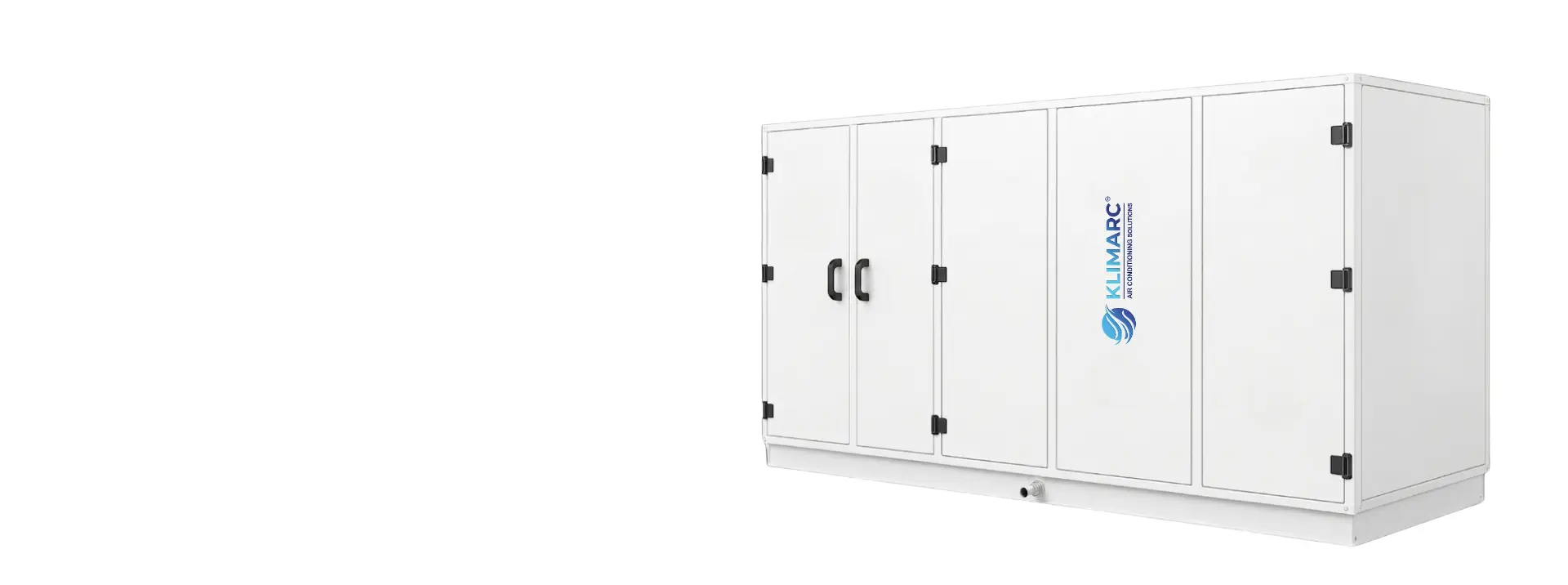
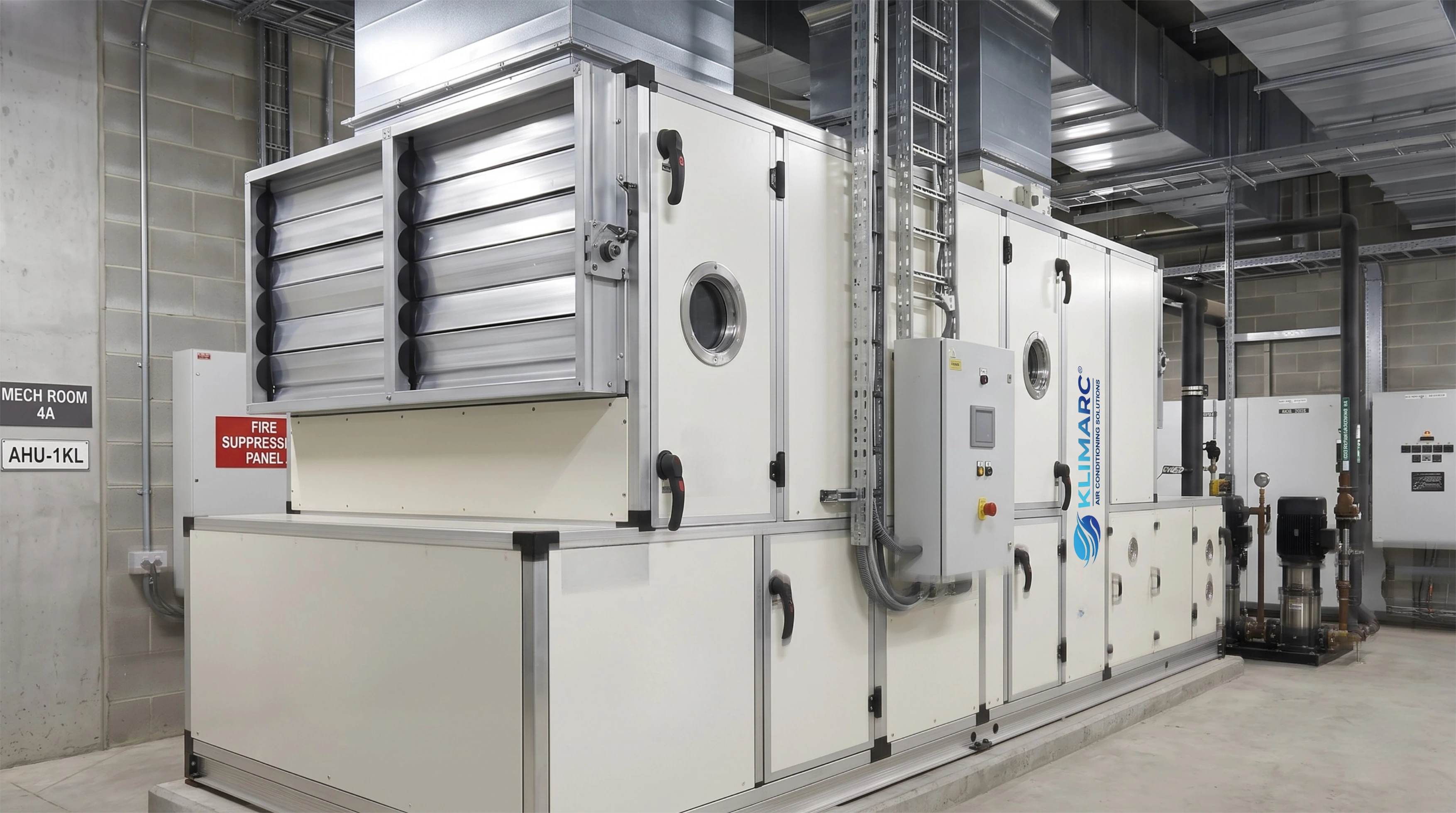
- Stage 2 (At the Plantroom or Rooftop): The KLIMARC Ecology Unit captures remaining fine smoke particles using an Electrostatic Precipitator (ESP) and removes all residual odors using deep-bed Activated Carbon before discharging air safely at street or rooftop level.
How UV-C Hoods Protect Downstream Ecology Units
When an untreated kitchen hood feeds raw grease into an Ecology Unit, sticky oil coats the electrostatic collector plates and clogs the activated carbon canisters within weeks. By placing a UV-C hood at the cooking line:
- ESP Cleaning Intervals Double: The electrostatic plates stay clean much longer because sticky grease vapors were already converted into dry, non-adhesive dust.
- Activated Carbon Lifespan Doubles: Without oil mist clogging the carbon pores, the carbon filters last twice as long, drastically reducing media replacement costs.
6. Construction & Built-In Human Safety Interlocks
Because high-intensity UV-C light can irritate human eyes and skin upon direct exposure, and ozone must never enter the kitchen workspace, every KVENT UV-C Hood is engineered with multiple fail-safe protections:
Heavy-Duty Stainless Steel Construction
- Material: Fabricated from 1.2 mm to 1.5 mm AISI 304 or marine-grade AISI 316 stainless steel with a clean brushed satin finish.
- Liquid-Tight Troughs: Precision-cut on 0.05 mm CNC fiber lasers and fully TIG-welded to prevent grease leaks into ceiling voids.
- IP65-Rated UV Lamp Cassettes: High-output amalgam lamps designed to operate reliably in hot canopy air temperatures up to 70°C.
Triple-Redundant Safety Controls
- Airflow Pressure Proving Switch: UV lamps will not turn on unless the exhaust fan is actively running and pulling air into the duct. This guarantees that 100% of generated ozone is drawn up the duct and never leaks into the kitchen.
- Instant Magnetic Door Interlocks: Tamper-proof magnetic switches monitor access panels and filter tracks. If a chef or technician removes a filter while the hood is on, the electrical circuit breaks in less than 0.1 seconds, instantly shutting off the UV lamps before anyone can be exposed.
- Smart Digital Control Panel: Wall-mounted control panel monitors individual lamp status, tracks run hours (lamps are rated for 10,000 to 12,000 hours of operation), and connects directly to the Building Management System (BMS) for status monitoring and automated fire alarm shutdown.
7. Frequently Asked Engineering Questions (FAQ)
Conclusion & Project Specification Support
Specifying KVENT UV-C Kitchen Exhaust Hoods transforms commercial kitchen ventilation from a hazardous, high-maintenance chore into a clean, automated system. By breaking down grease vapors directly at the cooking canopy, KVENT hoods keep ducts clean, satisfy building fire codes, lower maintenance costs, and provide superior odor control.
To request airflow sizing calculations, CAD/Revit submittal drawings, or a complete turnkey package combining KVENT Hoods, Fresh Air Units (FAHUs), and KLIMARC Kitchen Ecology Units:
- Explore our complete KVENT UV-C Hood Engineering Specifications
- Review our companion KLIMARC Kitchen Ecology Units and KVENT Water Mist Hoods
- Verify factory compliance on our Certifications & Standards Hub