In conventional commercial and residential buildings, ceiling-concealed Fan Coil Units (FCUs) were traditionally built as single-skin sheet metal boxes lined inside with glued-on fiberglass insulation. But in modern luxury hospitality, corporate headquarters, and high-end residences—across cities like Dubai, Riyadh, Abu Dhabi, and Doha—noise and air quality expectations are much higher.
International hotel brands (such as Four Seasons, Marriott, Ritz-Carlton, and Jumeirah) enforce strict acoustic criteria: guest bedrooms must not exceed NC 25 (Noise Criteria 25), and executive suites must stay under NC 30. When an air conditioner sits just one to two meters above a sleeping guest's head, a rattling or dripping unit quickly leads to complaints, poor reviews, and costly ceiling repairs.
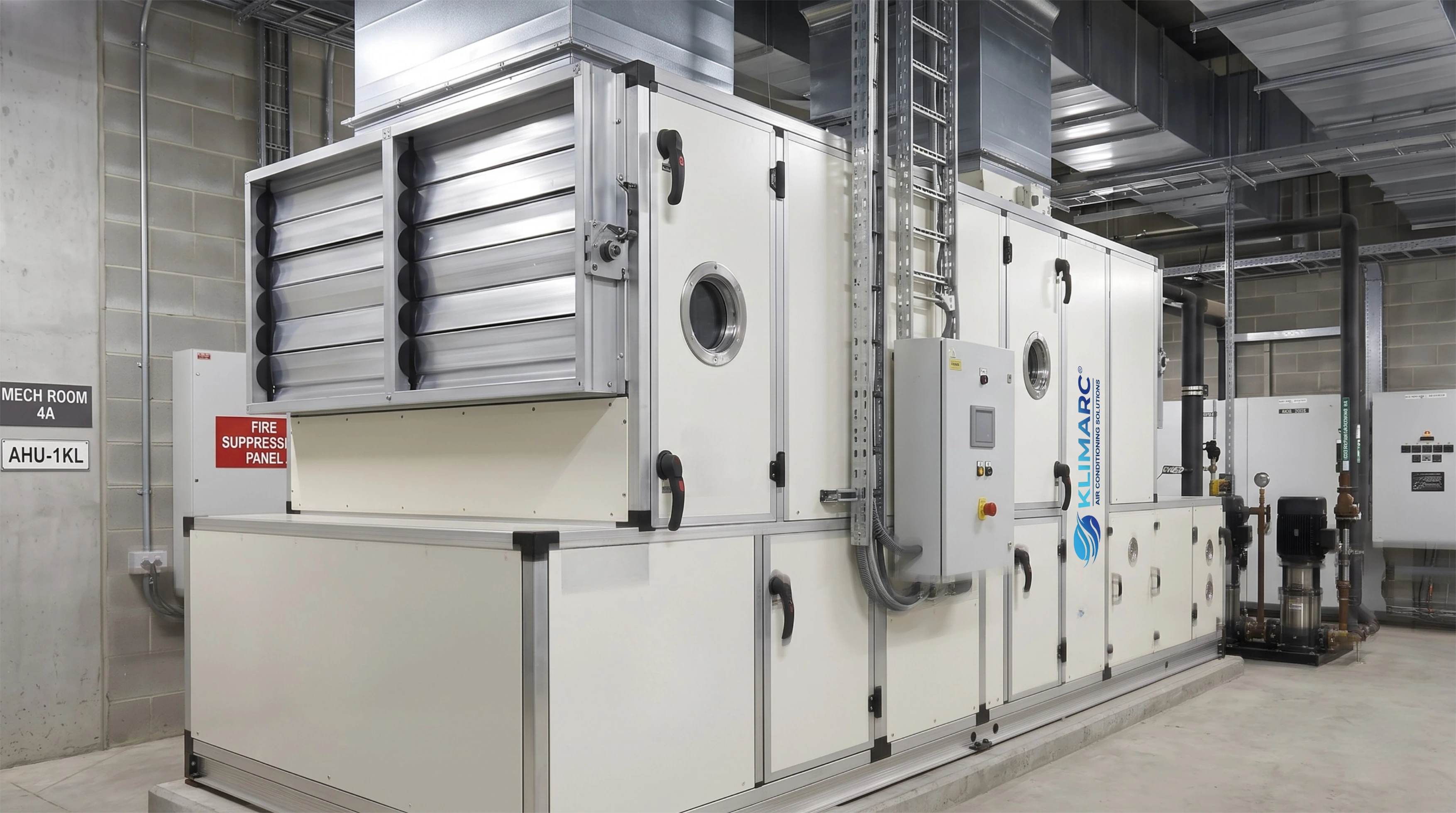
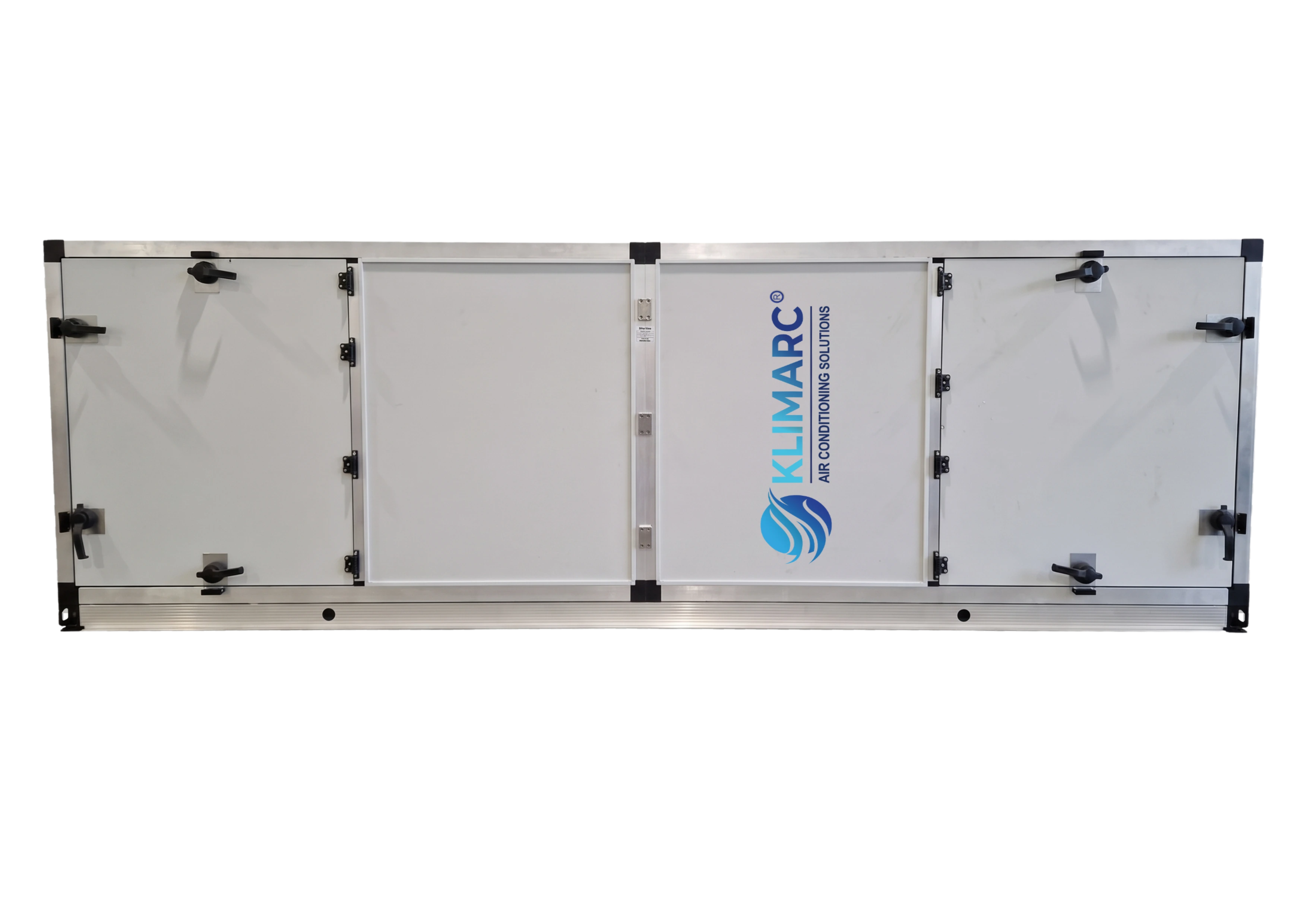
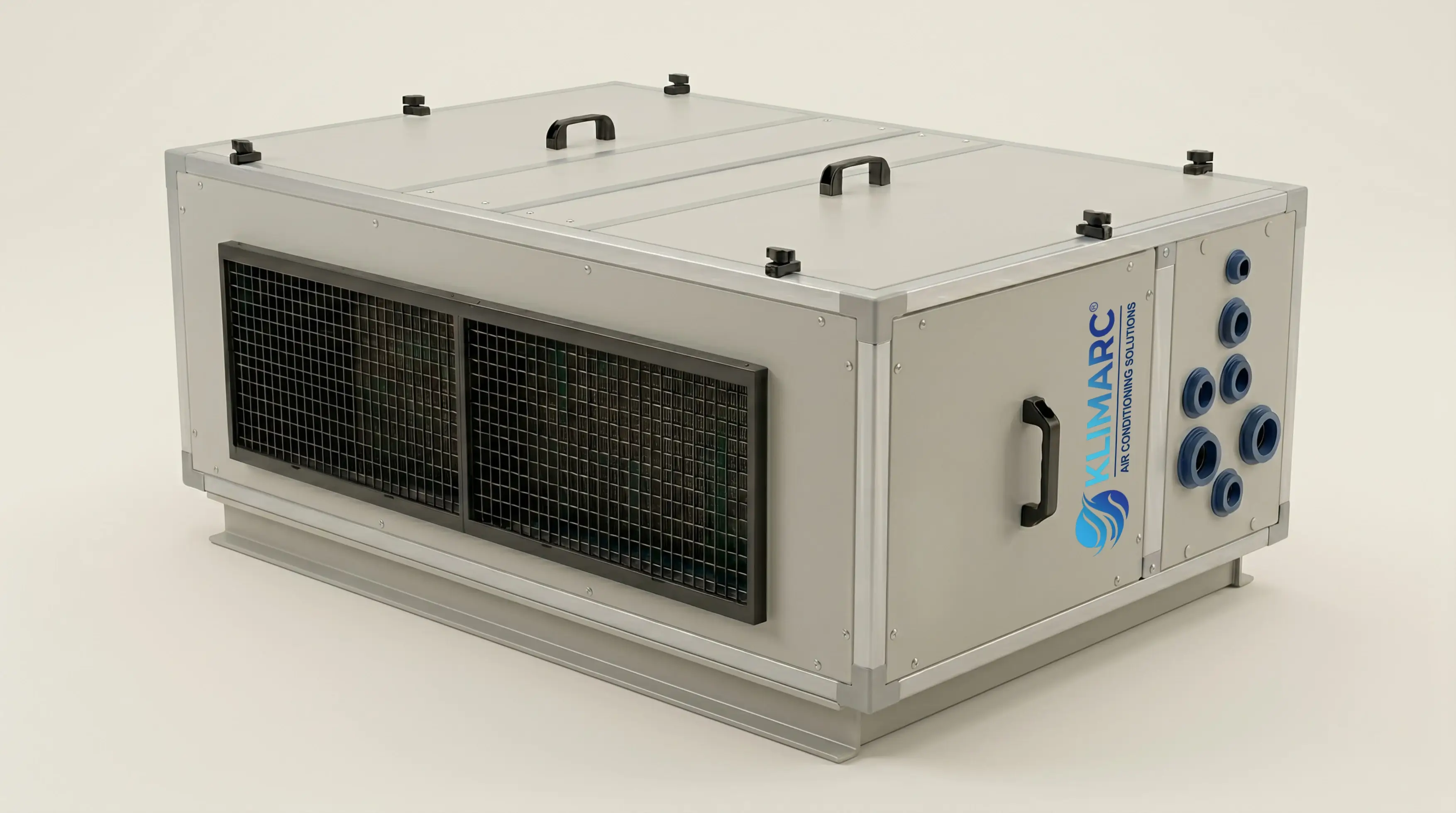
Manufactured in Ras Al Khaimah by Klima Air Conditioning Machines Manufacturing LLC, the KLIMARC Double-Skin FCU Series replaces flimsy single-skin boxes with an acoustically damped, thermally insulated sandwich panel architecture.
- Three-Path Noise Reduction: Double-skin panels packed with high-density rockwool (50 to 70 kg/m³) reduce casing breakout noise by 6 to 10 dB(A), effortlessly meeting strict NC 25–30 room criteria at normal fan speeds.
- Zero Fiberglass Shedding (VDI 6022 & ASHRAE 62.1): The insulation is completely sealed between two solid metal sheets. No raw fiberglass is exposed to moving air, ensuring 100% clean, fiber-free air and easy wipe-down sanitization.
- Complete Condensation Protection: Insulated sandwich walls and extended stainless steel drain pans stop exterior sweating in hot, humid ceiling spaces (> 36°C and 80% relative humidity).
- Quiet, Energy-Saving EC Motors: Stepless 0–10 V Electronically Commutated (EC) motors eliminate the electrical humming of older AC motors while slashing fan energy consumption by 50% to 70%.
1. Three-Path Acoustic Analysis: Radiated, Suction & Discharge Noise
When acoustic engineers evaluate a fan coil unit, looking at a single overall decibel (dB) number on a catalog sheet tells only part of the story. The sound generated by the spinning fan blower, electric motor, and turbulent air enters the room along three distinct physical paths:
How Sound Travels into an Occupied Room
The Sound Pressure Level (Lp) reaching an occupant's ear is determined by the unit's Sound Power Level (Lw), room acoustics, and sound reduction along each path:
Where Lw is the acoustic power of the fan, r is the distance to the listener (typically 1.5 to 2.0 meters), Qdir is the directivity factor, R is the room's acoustic absorption (curtains, carpets, furniture), and ΔLattenuation is the sound dampening provided by the casing, ceiling, and ductwork.
Path A: Casing Radiated Noise (Breakout Noise)
Radiated noise is sound that vibrates directly through the metal walls of the fan coil unit into the ceiling space and passes straight down through the ceiling drywall into the room.
- The Single-Skin Problem: A standard single-skin FCU consists of a thin sheet of metal (0.8 mm to 1.0 mm) with a thin layer of foam or fiberglass glued inside. Because it is lightweight, the sheet metal acts like the skin of a drum: pressure pulses from the fan blades cause the panels to vibrate and radiate low-frequency humming and rumbling (125 Hz to 250 Hz) straight through the ceiling.
- The Double-Skin Solution: Under the acoustic Mass-Spring-Mass Law, KLIMARC Double-Skin FCUs sandwich a dense 25 mm to 50 mm core of mineral rockwool (50–70 kg/m³) between two separate metal sheets. Sound waves hitting the first metal skin lose energy as they compress the dense rockwool "spring," resulting in a 6 to 10 dB reduction in breakout noise.
Path B: Suction Noise (Return Air Path)
Suction noise travels backward out of the fan inlet, through the return air plenum, and exits into the room through the return grille. Because the return path is usually very short, suction noise is often the most noticeable source of high-frequency whooshing and motor whine.
To tackle this, KLIMARC equips units with a factory-built, double-skin return plenum lined with sound-absorbing baffles. As air enters the expansion chamber, high-frequency turbulence and blade-passing tones are absorbed before reaching the return grille:
Path C: Discharge Noise (Supply Duct Path)
Discharge noise is sound carried forward with the chilled air as it blows through the cooling coil and into the supply air ducts.
In cheap units, fast-moving air exiting the fan strikes sharp edges inside the fan scroll, creating whistling air turbulence. KLIMARC uses dynamically balanced aluminum impellers and aerodynamically shaped fan housings. Air velocity across the cooling coil is kept smoothly below 2.0 m/s, eliminating hiss and air-rush noise before it reaches the room diffusers.
| Engineering Parameter | Standard Single-Skin FCU | KLIMARC Double-Skin FCU | Practical Impact |
|---|---|---|---|
| Casing Construction | Single 0.8 mm metal sheet + exposed glued fiberglass | Double-skin metal sheets + 25–50 mm (50–70 kg/m³) rockwool | Stops panel drumming and eliminates low-frequency rumbling. |
| Radiated Sound Power (Lw) | 47 to 53 dB(A) (Audible hum) | 37 to 42 dB(A) (Whisper quiet) | Effortlessly achieves NC 25 to NC 30 in hotel bedrooms. |
| Air Quality & Hygiene | Exposed fiberglass erodes over time into the air | 100% Encapsulated Insulation (VDI 6022 standard) | Zero glass fibers in room air; smooth, wipe-clean metal surfaces. |
| Fire Safety Rating | Combustible foam or resin binder | Class A1 Non-Combustible Mineral Rockwool | Zero smoke generation, meeting strict civil defense fire codes. |
| Ceiling Sweating Risk | High condensation risk in humid ceiling voids | Thermal-Break Double Wall (Sweat-free) | Protects drywall ceilings, light fixtures, and paint from water stains. |
2. Clean Indoor Air: Zero-Fiber Erosion & VDI 6022 Hygiene
Beyond noise, single-skin fan coils suffer from a serious indoor air quality flaw: deteriorating internal insulation.
In a conventional unit, acoustic fiberglass is glued directly onto the inside metal surface, right in the direct path of the fast-moving airstream (2.5 to 4.0 m/s) and right next to a wet, cold cooling coil. Over a few years of continuous operation, three problems develop:
- Fiber Erosion: High-speed air shears tiny synthetic glass fibers from the exposed insulation mat. These microscopic fibers blow through the ceiling diffusers directly into bedrooms, hospital wards, and offices, causing eye and respiratory irritation.
- Dust and Mold Accumulation: Fine dust that slips through air filters embeds deeply into the porous fiberglass. In the presence of high humidity around the cooling coil, this dust-caked insulation becomes a breeding ground for mold and bacteria, causing that familiar "musty hotel room" odor.
- Cleaning Impossibility: You cannot scrub or wash exposed fiberglass without tearing it apart and releasing more fibers.
The Hygienic Double-Skin Solution
In KLIMARC Double-Skin FCUs, the rockwool insulation is sealed inside a double-walled metal envelope:
- Zero Air-to-Fiber Contact: Moving air touches only smooth, non-porous metal. No fibers can ever enter the air supply.
- Fast, Safe Sanitization: Maintenance technicians can wipe down the entire internal casing with disinfectant in minutes without damaging the insulation core, satisfying international healthcare and hospitality hygiene standards (VDI 6022 and ASHRAE 62.1).
3. Stopping Ceiling Condensation: Dew-Point Physics
In coastal and humid regions, the space above a suspended ceiling is often unconditioned. Warm outdoor air frequently seeps into the ceiling void, creating conditions of 36°C (97°F) and 80% relative humidity.
Calculating the Ceiling Void Dew Point
Under psychrometric tables, air at 36°C and 80% relative humidity has a Dew-Point Temperature (Tdp) of 32.0°C. This means that if any surface in that ceiling space drops below 32.0°C, moisture in the air will instantly condense into liquid water droplets.
Meanwhile, inside the fan coil unit, chilled water enters at 5.5°C to 7.0°C, chilling the inside of the unit down to 12.0°C.
To keep the unit from "sweating," the outer surface temperature (Tsurf,ext) must remain strictly above the 32.0°C dew point:
- Single-Skin Failure: With thin 10 mm insulation, heat conducts rapidly through the casing. The exterior metal drops to 25°C–27°C—well below the 32.0°C dew point. Water droplets form continuously on the outside of the casing, eventually dripping onto drywall ceilings and causing water stains and mold.
- Double-Skin Protection: With 25 mm to 50 mm of high-density rockwool and thermal-break seals, the exterior skin stays warm and dry (typically above 33°C), preventing condensation from ever forming.
Dual Drain Pan Architecture
Condensate water must also be drained safely away:
- V-Sloped Primary Pan: Sloped continuously toward the drain pipe so water drains immediately rather than sitting stagnant (preventing bacterial growth).
- Extended Auxiliary Valve Tray: Extends under all control valves, balancing valves, and pipe fittings to catch any minor sweating from chilled water pipes.
4. Brushless EC Motors & AHRI-Certified Performance
A great casing needs equally great internal components. What is inside determines comfort and energy efficiency:
1. Variable-Speed Brushless EC Motors vs. 3-Speed AC Motors
Older 3-speed AC motors regulate airflow by stepping down electrical voltage across copper windings. This creates an audible 50 Hz/60 Hz electrical hum and noticeable jumps in noise when shifting speeds.
Modern KLIMARC FCUs feature Brushless DC / Electronically Commutated (EC) Motors controlled by a smooth 0–10 V signal:
- Silent Modulation: The motor uses permanent magnets and an electronic controller, operating silently without electrical hum even at ultra-low speeds.
- 50% to 70% Energy Savings: Under the Fan Affinity Laws (Power ∝ RPM³), slowing a fan down by half reduces its power consumption to just one-eighth. When an occupied room reaches its setpoint, the EC fan gently slows down, consuming just 15 to 25 Watts.
2. AHRI 440 & AHRI 410 Certified Coils
KLIMARC coils use 3/8" (9.52 mm) seamless copper tubes mechanically expanded into aluminum fins and tested underwater at 30 bar (435 psi). Certified under AHRI 440 and AHRI 410, their cooling performance is independently guaranteed so rooms stay at target temperature even during the hottest summer days.
3. Flexible Unit Configurations
- Ultra-Slim Concealed Units (KA-LSD): Compact 250 mm to 300 mm height designed to fit inside tight ceiling spaces in hotel entry foyers.
- High-Static Ducted Units (KA-HSD): Built for extended ductwork (up to 120 Pa–200 Pa static pressure) in large suites, retail stores, and open offices.
- Factory PICV Valve Packages: Pre-assembled, pressure-tested control valve kits that automatically maintain design water flow, preventing over-pumping and utility penalties.
5. Meeting Hotel Standards & Green Building Codes
Double-skin fan coil units help projects meet both international hotel brand requirements and regional sustainability codes:
- 5-Star Hotel Brand Standards: Major operators (Marriott, Hilton, Four Seasons, Accor) require guestroom FCUs to achieve NC 25 to NC 30 at Medium fan speed. This ensures whisper-quiet nights for guests.
- Green Building Codes (Estidama, Al Sa'fat, SBC 601): Reward projects that minimize fan energy through EC motors and eliminate indoor air contaminants by using non-eroding metal linings.
- Fire Safety (Civil Defense & NFPA 90A): Non-combustible Class A1 rockwool insulation generates zero smoke or toxic fumes in the event of a fire.
6. Frequently Asked Engineering Questions (FAQ)
Conclusion & Engineering Support
Specifying Double-Skin Fan Coil Units is the most effective way to guarantee peaceful, whisper-quiet rooms, clean indoor air, and zero ceiling leaks. Built in Ras Al Khaimah with high-density rockwool insulation, AHRI-certified coils, and quiet EC motors, KLIMARC Double-Skin FCUs deliver dependable comfort and long-term durability.
To request selection schedules, acoustic breakout calculations, or BIM models:
- Explore the KLIMARC Double-Skin FCU Range and Complete Product Catalog
- Pair your fan coils with KLIMARC ARC Air Handling Units (AHU) and Fresh Air Handling Units (FAHU)
- Review our credentials on the KLIMARC Certifications Hub or download engineering guides from our Downloads Center